
Home / Articles / Victron SmartSolar MPPT Sizing for Boats: 75/15 vs 100/30 vs 100/50
Choosing a Victron MPPT solar charge controller for a boat comes down to the two numbers in its name: maximum PV voltage and maximum battery charge current. At the time of writing, Victron lists nominal PV power on a 12 V bank of 220 W for the SmartSolar 75/15, 440 W for the 100/30 and 700 W for the 100/50.
What is an MPPT charge controller, and how does it differ from PWM?
An MPPT (maximum power point tracking) controller adjusts its input voltage to take the most power from the panels, then converts it to the voltage the battery needs.
A PWM (pulse width modulation) controller is essentially a switch between the panels and the battery, so array voltage is pulled down to near battery voltage. Compass Marine notes that 12 V nominal panels run at about 17–19 V while lead-acid batteries charge at 14.1–14.8 V, so with PWM the extra panel voltage is wasted.
Victron calls PWM a good low-cost choice only for small systems with cell temperatures of 45–75 °C, says MPPT harvests 10% to 40% more outside that band or in very low light, and recommends MPPT once a 12 V array exceeds a few hundred watts.
Sources differ on the real-world gain: at the time of writing Victron says SmartSolar harvests 30% more than PWM, while Compass Marine measured 10–20% on lead-acid and almost 21% in a 7-day LiFePO4 test, with gains only in bulk charging. For a small maintenance panel, see our guide to a solar charger for a boat battery.
What do the numbers in a Victron MPPT model name mean?
In a Victron solar charge controller name, the first number is the maximum PV voltage and the second is the maximum battery charge current.
A Victron MPPT 75/15 accepts up to 75 V from the panels and charges at up to 15 A; a 100/30 takes up to 100 V and delivers up to 30 A. The 100/30 and 100/50 work on 12 V or 24 V batteries.
| SmartSolar (at the time of writing) | Max PV Voc | Max charge current | Nominal PV power, 12 V / 24 V | Max PV Isc | Battery fuse |
|---|---|---|---|---|---|
| 75/15 | 75 V | 15 A | 220 W / 440 W | 15 A | 20–25 A |
| 100/30 | 100 V | 30 A | 440 W / 880 W | 35 A | 35–40 A |
| 100/50 | 100 V | 50 A | 700 W / 1400 W | 60 A | 55–70 A |
Output current caps charging watts: a 75/15 can put at most about 180 W (15 A x 12 V) into a 12 V battery, but about 360 W into a 24 V battery.
How do you size a Victron solar charge controller for a boat?
Size a Victron solar charge controller with three separate checks: array watts, cold-weather open-circuit voltage (Voc) and short-circuit current (Isc), each against the model's limit.
Watts. Compare total panel wattage with nominal PV power for your battery voltage; Victron's MPPT sizing calculator estimates daily yield by array and location.
Voc, the panel voltage with no load. Array Voc is panel Voc times the number of panels in series, and it must not exceed the controller's maximum PV voltage. Check it at the coldest expected temperature, because Voc rises as it gets colder; Victron says to use the panel's temperature coefficient, since Voc rises below 25 °C. Where nights approach or drop below 10 °C, keep an extra 10% margin below the maximum.
Isc. Array Isc is panel Isc times the number of panels in parallel; series panels do not change it.
Start-up voltage. Victron's manual for the 75/15 and other models up to the 100/20 says charging starts when PV voltage is 5 V above battery voltage and continues while it stays at least 1 V above. For a 12 V battery on a 75 V controller, Victron gives a minimum of 36 cells in series, a recommended 72 and a maximum of 108.
What happens if the array is too big?
Too many watts is managed; too many volts is a fault. With more PV wattage than nominal PV power, the charger limits its input.
Victron's calculator allows 130% oversizing, generally costing under 1% of annual energy, often for winter output. On the 75/15 and other models up to the 100/20, PV voltage above the rated maximum stops charging with error #33, absorption and float LEDs blinking rapidly, until voltage falls 5 V below the maximum. That overvoltage can damage the controller.
Series, parallel or one controller per panel?
On a boat with unavoidable shade, BoatUS (citing Rob Warren of Coastal Climate Control) recommends one controller per panel when possible and practical.
Where that is impractical, BoatUS advises parallel wiring so shade on one panel does not cut the other's output.
- Series: stays above start-up voltage in low morning and evening light, but shading one panel can reduce the whole string. Partial shade can create several power peaks, and conventional MPPT controllers may lock onto a lower one.
- Parallel: keeps voltage the same and adds current, handles shade better, but needs thicker cable.
At the time of writing, SmartSolar controllers in a VE.Smart network charge as one large charger, but the network cannot set a shared maximum current; for differently facing arrays on a small bank, Victron suggests a GX device with DVCC.
Load output on the 75/15 vs the 100/30 and 100/50
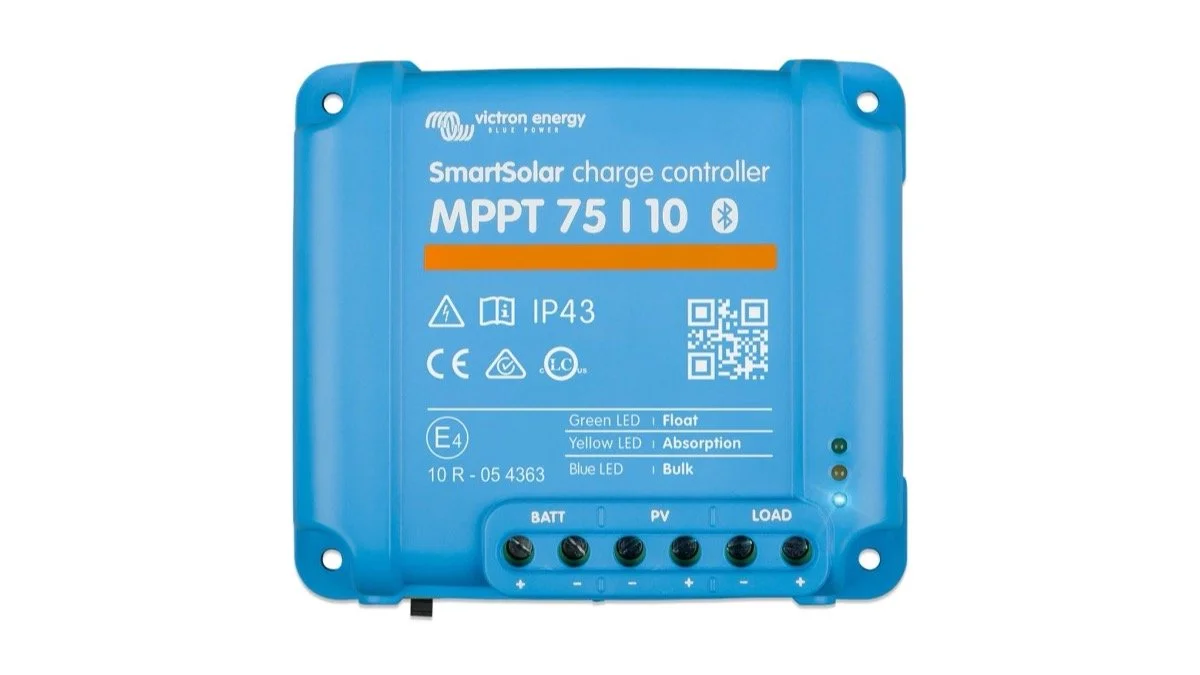
The SmartSolar 75/15 has a physical load output for small DC loads such as lights; the 100/30 and 100/50 do not.
At the time of writing, that output is rated 15 A or 20 A depending on model and is short-circuit proof; inverters go directly to the battery. The larger models can use a virtual load output through a VE.Direct TX cable.
What to check before you buy
A Victron MPPT choice needs these numbers from the panels and boat first.
- Each panel's watts, Voc, Isc, cell count and Voc temperature coefficient.
- The coldest night in your cruising area.
- House bank voltage and chemistry.
- A mounting spot within 3 m (about 10 ft) of the battery, never directly above it.
- Room to add panels later, up to the controller's limit.
- Panels without optimizers; optimizers can cause irreparable damage to the solar charger.
How to install a Victron SmartSolar MPPT
A Victron SmartSolar MPPT must follow the manual's connection order; the wrong sequence can disable or damage the charger.
High DC voltage is present whenever the panels are in light; isolate both DC and PV before touching wiring.
- Mount the controller within 3 m (about 10 ft) of the battery, never directly above it, to avoid damage from battery gassing.
- Fit a means to disconnect all current-carrying PV conductors and a battery fuse in Victron's range for the model.
- Use flexible multi-stranded copper cable with strands no thicker than 0.4 mm (AWG26); rigid or thick strands cause high contact resistance, overheating and eventually fire.
- Keep battery-cable voltage drop within 2.5%.
- Connect the battery first, wait 10 seconds for automatic voltage detection and confirm system voltage in VictronConnect.
- Connect DC loads, then PV, then the VE.Direct cable if used.
- Select the charge profile in VictronConnect.
PV connections can burn from over 30 A per MC4 pair, poor crimps or low-quality MC4 connectors.
Charge settings for lithium and lead-acid, and monitoring
The VictronConnect app sets the SmartSolar charge profile, with 8 presets or a fully programmable algorithm at the time of writing.
On the 75/15 and other models up to the 100/20, default 12 V lead-acid settings are 14.4 V absorption and 13.8 V float. For LiFePO4, Victron recommends 14.2 V absorption for 2 hours on 12 V, or 28.4 V on 24 V. Sources differ on LiFePO4 float: the manual's settings table gives 13.2 V, while a paragraph on the same page says 13.5 V; follow your battery maker's figure. The LiFePO4 preset sets tail current to 0 A for cell balancing, turns temperature compensation off and enables a low-temperature charge cut-off. Maximum charge current can be lowered for a small bank. Do not equalize gel, AGM, VRLA or lithium batteries.
SmartSolar models have Bluetooth built in; BlueSolar models do not. At the time of writing, VictronConnect shows live data, up to 30 days of history and errors, and updates firmware. A VE.Direct cable links the controller to a GX device, and through VRM its data and alarms are visible remotely. See our Victron Cerbo GX guide for that setup and our SmartShunt vs BMV-712 comparison for state of charge.
Common mistakes with Victron MPPT installs
Victron MPPT mistakes below each match a published warning.
- Checking Voc at room temperature instead of the coldest morning.
- Connecting PV before the battery without setting system voltage manually.
- Wiring shaded panels in series.
- Using coarse or rigid cable.
- Ignoring a ground fault warning: the charger has no internal ground fault protection, and when a ground fault is indicated, battery terminals and circuits may be ungrounded and hazardous.
What can an owner do alone, and when is a marine electrician needed?
A boat owner can run the sizing checks, change VictronConnect settings and update firmware.
Wiring is where risk rises, because the PV side is live in daylight. Bring in a marine electrician for new PV and battery cable runs, fuses and disconnects, multi-controller systems with DVCC, or any ground fault indication.
How eMarine Systems can help
eMarine Systems works with Victron and serves boats dockside across Miami-Dade, Broward and Palm Beach counties.
Each project starts with a power demand analysis, system sizing, component matching and compatibility verification. See our boat solar panel installation service and our Victron installation work. Owners wiring their own system can find solar charge controllers in our online store.
eMarine Systems is an ABYC member. eMarine does not do hull, fiberglass, engine mechanical or propeller work, and installation cost is quoted after an onboard inspection. Call (954) 520-2055.
Frequently asked questions
Which Victron MPPT fits two 200 W panels on a 12 V battery?
By wattage, a 100/30 fits: 400 W exceeds the 75/15's 220 W on 12 V but sits within the 100/30's 440 W, at the time of writing. Then confirm cold-weather Voc stays below 100 V and Isc below 35 A.
When do you need the Victron MPPT 100/50 instead of the 100/30?
The 100/50 is the next step when the array exceeds the 100/30's nominal power, which at the time of writing is 440 W on 12 V against 700 W for the 100/50; above that, the 100/30 limits its input. It also needs a larger 55–70 A battery fuse.
Can a Victron solar charge controller be oversized with panels?
Yes in watts, not in volts. Extra wattage makes the charger limit its input, and Victron's calculator allows up to 130% oversizing; overvoltage stops charging and can damage the controller.
How do I monitor a Victron MPPT from my phone?
Use VictronConnect over the SmartSolar's built-in Bluetooth for live data and history. For remote access, connect it by VE.Direct to a GX device on VRM.