
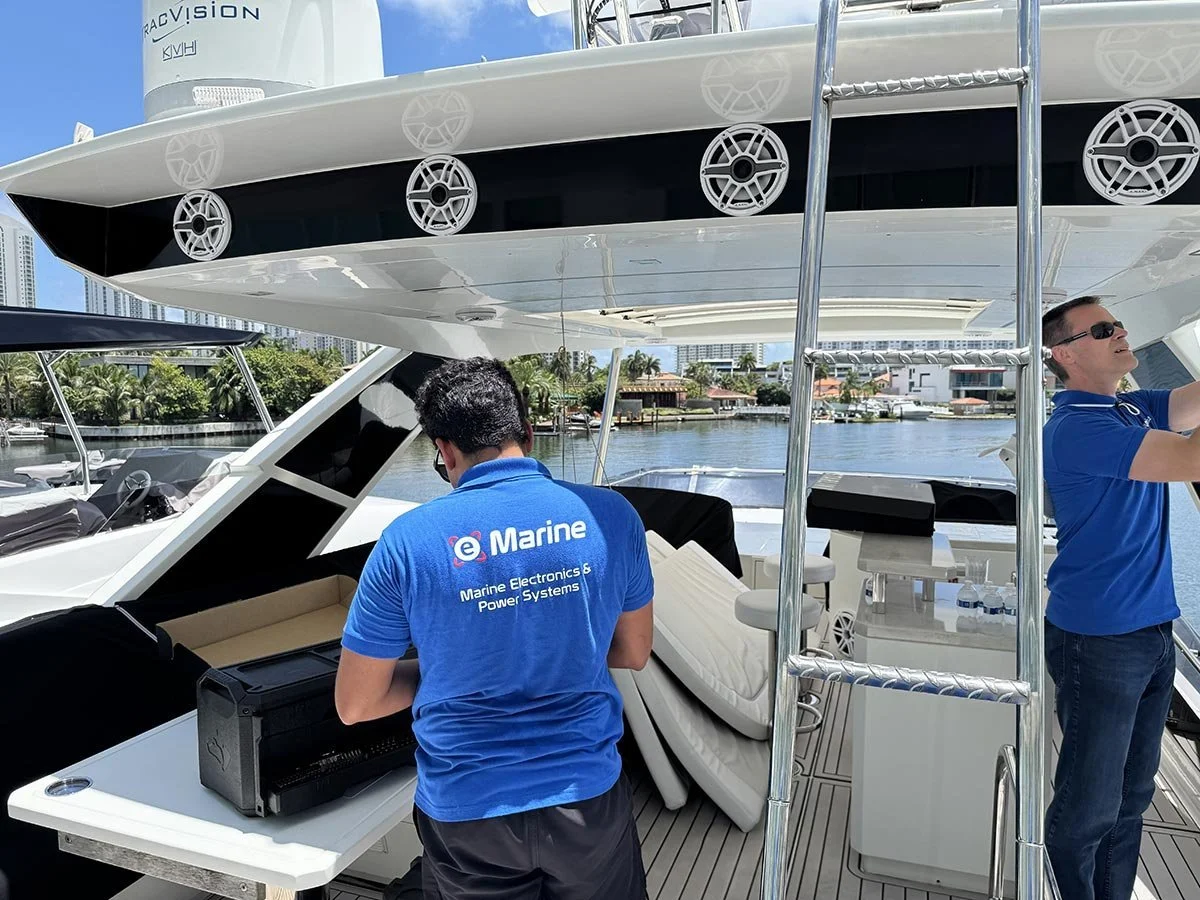
Home / Articles / Starlink on a Boat: Mini or Standard, and What to Plan Before You Buy
Starlink works on a boat with either the Starlink Mini or the Starlink Standard kit, as long as the antenna sees enough sky and the service plan allows use in motion and on the ocean. The Mini is lighter, draws less power and has a built-in router; the Standard covers more area with a separate router.
Does Starlink work on a boat?
Yes, Starlink works on a boat when the kit is suited to in-motion use, the plan allows it, and the antenna has a clear view of the sky.
The Mini and the Standard are both electronic phased arrays that track satellites without physically moving. Actuated (motorized) Starlinks, such as the Standard Actuated, are not designed for in-motion use. Installing or using an actuated unit on a moving boat may cause injury or property damage.
A June 2022 FCC order allows SpaceX to operate earth stations on vessels in US territorial waters and international waters worldwide. The FCC granted Starlink's US in-motion authorization on a non-interference-protected basis in the 12.2–12.7 GHz band, so service there is not protected from interference.
What is the difference between Starlink Mini and Standard?
Starlink Mini is compact, lighter and lower-draw with a built-in router, while the Standard kit is heavier, uses a separate router and covers a larger Wi-Fi area.
| Starlink Mini | Starlink Standard | |
|---|---|---|
| Starlink's positioning | Compact, portable, basic internet use | High-demand everyday use, larger Wi-Fi coverage |
| Boat use (West Marine) | Small boats, portability, backup | Boats mostly at a dock or mooring needing wider Wi-Fi |
| Antenna weight | 1.10 kg (2.43 lb); 1.53 kg (3.37 lb) with kickstand and 15 m cable | 2.9 kg (6.4 lb); 3.8 kg (8.3 lb) with kickstand and 15 m cable |
| Average power, AC input | 20–40 W, 15 W idle | 75–100 W, 20 W idle |
| Router and Wi-Fi | Built in: Wi-Fi 5, one Ethernet LAN port, up to 112 m² (1,200 ft²) | Separate Router 3: Wi-Fi 6, two LAN ports, up to 297 m² (3,200 ft²) |
| Water rating | IP67 Type 4 with DC cable and Starlink Plug installed | Antenna IP67 Type 4; Router 3 indoor, IP56 |
| Mounting in the box | Kickstand, pipe adapter and flat mount for 31–50 mm (1.25–2 in) poles | Detachable kickstand |
The Mini antenna measures 298.5 x 259 x 38.5 mm (11.75 x 10.2 x 1.45 in) with a 110° field of view. Starlink gives two Mini draw figures: 25–40 W average on the spec sheet, 20–40 W in the Help Center, where the figure includes router, power supply and cables.
Can you use Starlink Mini on a boat?
Yes, Starlink Mini can be used on a boat; BoatUS suggests it for rail mounting, and West Marine for small boats, portability and backup.
Keep the Starlink Plug installed: with a standard RJ45 Ethernet cable in its place, the Mini is no longer rated IP67.
Will regular Starlink work on a boat?
Yes, the Standard kit can be used on boats, but Starlink says it is more sensitive to obstructions than the Performance kits because of its narrower field of view.
The Standard's Router 3 is meant for indoor use and is rated IP56, so it belongs in the cabin or console. Starlink offers DC power supply options for boats and says no pure sine-wave inverter is needed when the DC source stays within the supply's limits. The Standard DC-DC Power Supply accepts 12–48 V DC (30 A) and outputs 56 V at 3.57 A. Starlink's boat-install guide still mentions an inverter for DC sources, so confirm the power path for your exact kit.
How is the Starlink Mini powered on a boat?
Starlink Mini accepts 12–48 V DC rated 60 W through its power cable, a USB-C Power Delivery source of at least 100 W, or the Mini Car Adapter.
- Supplied power supply and cable: Starlink only promises full performance with these.
- USB-C: the Mini will not run on a supply rated below 100 W, including 65 W supplies. Do not plug a USB-C charger straight into the Mini; use the USB-C to barrel jack cable.
- Mini Car Adapter: runs from a 12–24 V auxiliary (cigarette-lighter) outlet via USB-C.
- No power over Ethernet: the Mini always needs its power cable.
A BoatUS writer could not start a Mini from the boat's 12-volt batteries with a plug-in cord; it ran through an inverter, but the startup surge and draw meant running the engine. Starlink publishes power use in watts, so plan battery draw from the averages in the table.
How do you mount Starlink on a boat?
Mount Starlink with a clear view at 20° elevation above the horizon all around, raising it on a mast or pole where needed, especially in marinas.
For a fixed mount, BoatUS recommends commercial systems such as Seaview, NavPod or Scanstrut. Third-party metal mounts that wrap around the base, or placing the terminal on metal, may interfere with GPS and are not supported. If the same arch carries radar, see our guide to open array vs dome radar.
- Check the sky from each candidate spot: 20° clear all around, with no mast, pole or hardtop in the way.
- Choose a fixed pole or commercial mount, or the kickstand for removable use, and keep the base off metal.
- Fasten the mount with removable thread locker and point connectors down or sideways. Secure the antenna so it cannot slide overboard or slam onto the deck in rough seas.
- Route the cable through a cable seal, and keep the Mini's Starlink Plug in place.
- Connect power from a supported source: the Mini's supplied cable or adapter, or the Standard's DC supply.
- Power up and watch for outages, dropped packets or low speeds that point to an obstruction.
Do not put a protective cover over the antenna; Starlink says it degrades performance. Keep the antenna off dashboards behind glass: one BoatUS writer's antenna there got hot enough to crack the gauges below.
What limits Starlink on the water?
Obstructions, vessel motion, heavy weather and national rules all limit Starlink on the water.
- Obstructions: a mast, pole or roof in the path causes interruptions, though a partial view is often enough. A persistent obstruction brings intermittent outages and lower speeds.
- Motion: roll or pitch beyond 20 degrees can cause brief 1–2 second interruptions.
- Weather: heavy rain and hail can cause short dropouts, but full outages are rare. In the path of hurricane-force winds, bring Starlink and cables indoors if safe to do so; if a cable gets wet, let it dry fully before reconnecting.
- Location: territorial waters require local government approval, and licensing by SpaceX or the user. A terminal may lose internet in the waters of a country that prohibits Starlink.
Which Starlink plan type works on a boat?
A Starlink plan for a boat underway must allow in-motion use and, for offshore trips, ocean use; international waters require an eligible in-motion plan.
Starlink plan names, terms and availability change over time and vary by location. Choose a plan that allows in-motion and ocean use for the waters you cruise, and check current plan terms on starlink.com before you buy. eMarine Systems does not sell Starlink service plans; plan terms and prices are set by Starlink and its service providers.
How do you spread Starlink Wi-Fi through the boat?
Starlink Wi-Fi spreads through a boat with mesh routers or a third-party router, connected by Ethernet where cable runs allow.
- Mini: Starlink recommends adding Starlink routers as wired or wireless mesh for more coverage. A third-party router connects to the Mini's Ethernet port with bypass mode on.
- Standard: for wired mesh, a LAN port on Router 3 feeds the WAN port of the mesh node. A third-party router connects to a Router 3 LAN port in Bypass Mode, since the power supply has no Ethernet port.
- Two terminals: a third-party router can combine multiple Starlinks into one network with load balancing and failover.
Starlink's guidance covers failover between Starlinks, not cellular backup. For helm electronics, see our Garmin vs Simrad vs Raymarine comparison.
What to check before you buy
- Where you cruise: inland, coastal, or international waters, and which countries you visit.
- Plan terms: current in-motion and ocean rules on starlink.com.
- Mount spot: clear 20° view all around; 31–50 mm (1.25–2 in) pole for the Mini's adapter.
- Power: a DC source within 12–48 V for the Mini, or within the Standard DC supply's limits.
- Router location: a dry indoor spot for Router 3, and Wi-Fi reach to every cabin.
Common mistakes with Starlink on boats
- Running an actuated (motorized) Starlink underway.
- Powering the Mini from a USB-C supply under 100 W, or plugging a charger straight into it.
- Swapping the Mini's Starlink Plug for a plain RJ45 cable outdoors, which ends the IP67 rating.
- Mounting on metal or in a wrap-around metal mount.
- Covering the antenna against weather.
- Leaving Router 3 outside when it is meant for indoor use.
What can an owner do alone, and when is a marine electrician needed?
An owner can run a portable Mini on its kickstand and supplied power supply; hardwired DC power, deck penetrations and high mounts call for a marine electrician.
Owner tasks also include testing spots for obstructions and setting up Wi-Fi or mesh routers.
How eMarine Systems can help
eMarine Systems installs Starlink Flat High Performance and Starlink Maritime terminals on radar arches and hardtops. It routes the cable, integrates DC power, and sets up routers, switches, Wi-Fi access points and cellular failover.
Details are on the Starlink installation service page and the boat internet and Wi-Fi service page. Each eMarine project starts with a power demand analysis, system sizing and compatibility verification, with technical support after commissioning. eMarine is an ABYC member and provides dockside service across Miami-Dade, Broward and Palm Beach counties.
eMarine does not sell Starlink service plans, and installation cost is quoted after an onboard inspection. Call the Fort Lauderdale office at (954) 520-2055.
Frequently asked questions
Which Starlink suits a small boat?
Starlink Mini is the kit West Marine suggests for small boats, portability and backup. Starlink positions the Mini for compact, portable, basic internet use, and its Help Center puts the Mini's average draw at 20–40 W.
Does Starlink work offshore?
Starlink works in international waters only with an eligible in-motion plan, so check current plan terms on starlink.com. A terminal may lose service in the waters of a country that prohibits Starlink.
Can I run Starlink Mini from a 12-volt battery?
A 12-volt system is within the Mini's 12–48 V DC input range. Starlink only promises full performance with the included power supply and cable, and one BoatUS writer needed an inverter to start a Mini.
Does rain or rough water knock out Starlink?
Rain and rough water usually cause short interruptions, not full outages. Roll or pitch beyond 20 degrees can cause 1–2 second interruptions.