
Home / Articles / Solar Charger for a Boat Battery: Trickle Panel or a Full MPPT System?
A solar charger for a boat battery comes in two sizes. A small trickle (maintainer) panel only keeps a charged battery topped up while the boat sits off shore power, on a mooring or a lift. A full system with a charge controller, sized to your daily amp-hours, also replaces what electronics and house loads use.
What is the difference between a solar trickle charger and a full system?
A solar trickle charger offsets the battery's slow self-discharge, while a full charging system is sized to replace the energy you use every day.
Wet-cell batteries lose about 1% of their amp-hour rating per day, more in hot weather. Battle Born describes trickle charging as suited to lead-acid starting batteries. On a mooring, BoatUS calls solar the only practical way to keep batteries at full charge. Around 100 W can run fish finders and stereos and charge phones by day, per Battle Born.
| Situation | Sizing guidance from the sources | Charge controller |
|---|---|---|
| Maintaining a battery on a mooring | BoatUS: 3.5 W per 100 Ah; a 10 W panel gives about 3–5 Ah per day | Sources differ |
| Slip with bilge pump, clock, occasional electronics | West Marine: 50–100 W | Required, per West Marine |
| Cruising with daily electronics and house loads | West Marine: 200–400 W | Required; AGM-compatible MPPT for AGM |
| Boat lift battery | Lake Lite: heavier boat, larger panel; size up when unsure | Sources differ; ShoreStation's 20 W 24 V panel ships without one |
Can a solar panel overcharge a boat battery?
A solar panel wired straight to a boat battery can overcharge it, particularly in full sun, says West Marine, which calls the charge controller a required component.
Panel output is not conditioned for the battery; the controller regulates the current and voltage that reach it, Battle Born explains.
Sources differ on whether a very small panel can skip the controller:
- No controller below a threshold: West Marine's West Advisor says panels under 1.5% of the battery's amp-hour capacity need no regulation, so 1.5 A is the largest unregulated panel on a 100 Ah battery. BoatUS (2019) says about 1%. At the time of writing, ShoreStation ships its 20 W 24 V lift panel without a controller, citing its lower current.
- Always a controller: BoatUS (2024) calls sizing a panel to avoid a controller false economy. West Marine's solar FAQ says a controller is not optional.
How do you size a marine solar charger for daily use?
Sizing a marine solar charger starts with daily amp-hours: multiply each device's amp draw by its daily hours of use and add the results.
West Marine then multiplies panel watts by local peak sun hours, typically 4 to 6 h on most US coasts at the time of writing, and divides by 12 V to get daily amp-hours. In Victron's example, 720 Wh per day on 12 V is about 60 Ah, and with 5 peak sun hours needs about a 144 W array.
Why rated watts are not what the battery gets
A panel's rated watts appear only around noon, so BoatUS expects about five hours of rated output per day.
West Marine says a clear day typically delivers 70 to 85% of rated wattage after heat, sun angle, wiring and controller losses; light cloud gives about 50 to 75%, heavy overcast 10 to 25%. By West Marine's formula, a 100 W panel with 5 peak sun hours works out to about 42 Ah per day (100 x 5 / 12). Sources differ on the real daily yield: West Marine's FAQ gives two different ranges, and Battle Born a third figure.
Lithium, AGM and gel batteries on solar
A lithium battery does not need a float charge, and holding it at full voltage for long periods can shorten its life, Battle Born says.
For 12 V lithium, Battle Born says the controller usually targets 14.2 to 14.6 V, then tapers current and stops. At the time of writing, Genasun lithium controllers use the fixed CC/CV (constant current, then constant voltage) profile marked on the unit, so check that voltage against the pack's specifications. Never connect the solar panel negative to the battery negative on a Genasun GV-5; the batteries may be damaged.
Genasun recommends a BMS (battery management system) that can disconnect the solar controller if any cell leaves its rated temperature, current or voltage range. Skipping that protection may result in property damage, injury or death.
AGM batteries work well on solar when charged by an AGM-compatible MPPT (maximum power point tracking) controller, and gel batteries need a gel-specific profile, says West Marine. Our Victron MPPT sizing guide compares controller sizes.
Which marine solar panel type fits your boat?
Marine solar panel type depends on the mounting spot: rigid panels suit arches, davits and hardtops, while flexible panels fit canvas and curved decks.
- Rigid crystalline: West Marine calls these the most efficient and durable option. Compass Marine found a 125 W rigid panel with its frame added over 40 lb to a bimini.
- Semi-flexible: Thin and light, these follow dodgers and biminis; Compass Marine's replacement weighed under 5 lb. Flush-mounted flexible panels can produce 2 to 15% less than rigid panels with airflow, per Victron. Do not walk on flexible panels unless the maker allows it; most can crack at the cell level, causing burns and lost output.
- Rollable and foldable: Rollable panels mount with corner grommets and stow easily; foldable ones are less weatherproof and meant for temporary use.
A marine solar panel kit bundles matched parts; Lake Lite's 12 V lift kit, for example, includes the panel, regulator, mounting arm, wiring and hardware at the time of writing. Compare solar charger kits with individual solar panels if you already have a controller.
How do you choose a solar panel for a boat lift?
A solar panel for a boat lift recharges the lift motor's battery between lift cycles and, on lifts with wireless controls such as ShoreStation FlexPower, covers their standby draw.
At the time of writing, ShoreStation says its DC lift gets 6 to 8 cycles per full charge and recommends deep-cycle Group 24 marine batteries. Its lift solar charger manual notes FlexPower wireless controllers draw current even when idle. Lake Lite notes a 24 V lift uses two 12 V batteries and lifts about twice as fast, and more weight needs a larger panel.
ShoreStation's manual says to tilt the panel south at your latitude minus 15 degrees. ShoreStation warns never to connect a 24 V panel to a 12 V lift system, because it could damage the battery.
What to check before you buy
A solar charger purchase starts with your battery bank and mounting space:
- System voltage, 12 V or 24 V; never pair a 24 V panel with a 12 V system.
- Battery chemistry and the charge voltage it needs.
- Daily amp-hours from your own device list.
- An unshaded spot clear of spars, antennas and rigging wires.
- Cell count of a maintainer panel: 33 or more.
- Whether the battery charges now; if not, see boat battery not charging first.
How to mount and wire a solar charger
A solar charger is wired from the panel to the charge controller first, then to the battery, per BoatUS. Work in this order:
- Mount the panel horizontally, as BoatUS advises, clear of the shadow of spars, antennas and even a thin wire; raise deck panels for airflow, because heat reduces output.
- Size the cable: BoatUS multiplies the panel's rated amps by 1.25 and the panel-to-battery run length by 2.
- Mount the charge controller below decks, as close to the battery as possible.
- Fit an in-line fuse or breaker on the controller-to-battery positive. Without a fuse close to the battery, a short in the solar wiring is a dead short across the battery, with fire a likely consequence. Sources differ on distance: BoatUS cites ABYC at 7 inches from the battery or DC connection point, West Marine says 18 inches from the terminal. For the GV-5, Genasun's manual currently calls for a fast-acting fuse or breaker of 10 A or less.
- Make the final battery connection last, away from lead-acid batteries that have recently been charging: they can create explosive gases, and a short can draw thousands of amps.
Common mistakes with boat solar chargers
Common boat solar charger mistakes involve shade, heat, voltage and fusing:
- Mounting where a mast, antenna or rigging wire shades the panel.
- Laying a panel flat on deck with no air gap.
- Connecting a 24 V panel to a 12 V battery.
- Leaving the controller-to-battery positive unfused.
- Holding lithium at full voltage on a float profile.
- Expecting nameplate watts every day.
What can you install yourself, and when do you need a marine electrician?
The simplest solar jobs for an owner are a trickle charger or a flexible panel: West Marine rates them 1/10 and 2/10 in difficulty.
West Marine rates adding a charge controller at 4/10 and two panels on a dodger or radar arch at 8/10. BoatUS advises starting with a qualified marine solar specialist. Victron says voltages above 50 V are generally considered dangerous and should be handled only by a qualified technician. Call a marine electrician for new cable runs, a lithium bank, or a battery that still will not hold a charge.
How eMarine Systems can help
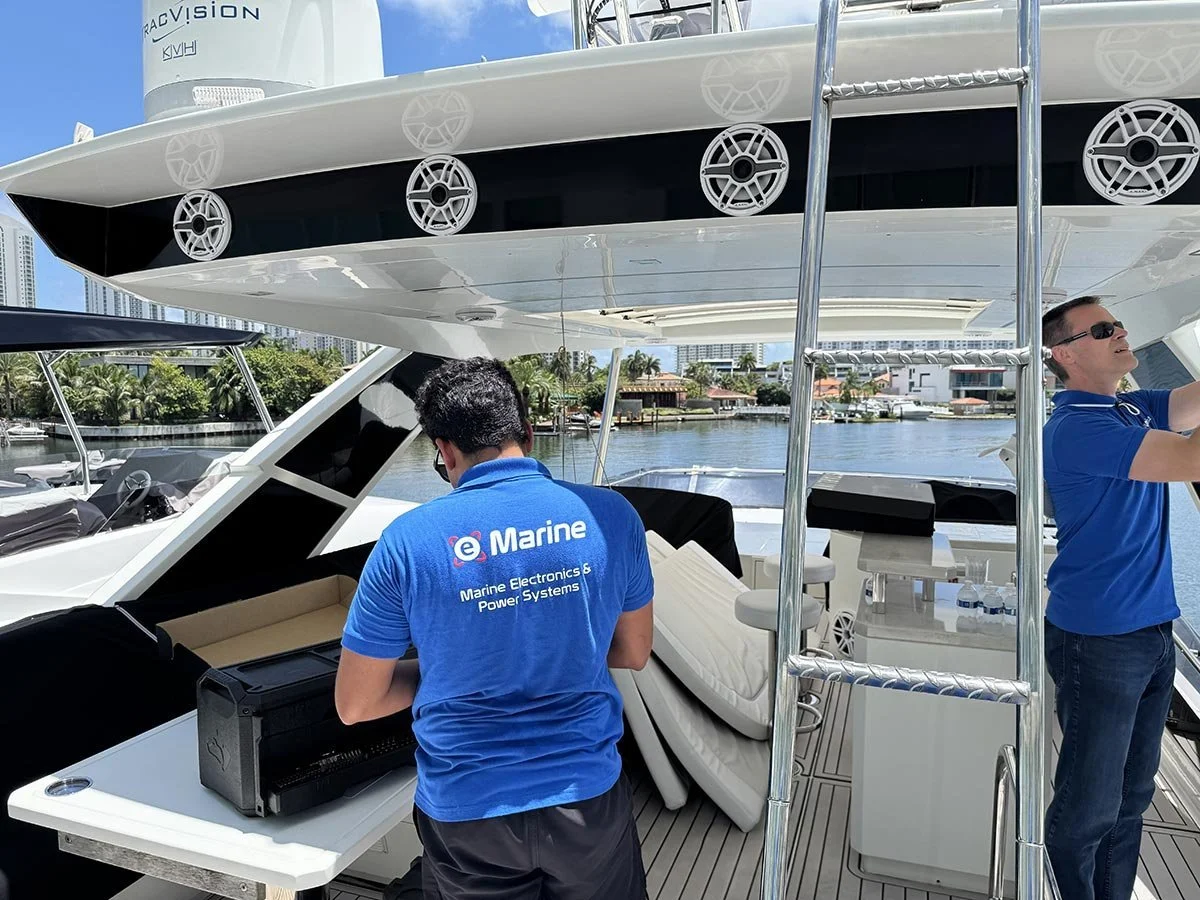
eMarine Systems handles boat solar panel installation dockside at marinas across Miami-Dade, Broward and Palm Beach counties. Each project starts with a power demand analysis, system sizing, component matching and compatibility verification, with technical support after commissioning.
The team also does boat battery replacement and boat lift repair. eMarine Systems is an ABYC member.
eMarine does not do hull, fiberglass, engine mechanical or propeller work, and cost is quoted after an onboard inspection. Call (954) 520-2055.
Frequently asked questions
How many watts of solar do I need to maintain a boat battery?
Sources differ, depending on what the panel must cover. BoatUS uses 3.5 W per 100 Ah to offset self-discharge, while West Marine suggests 50 to 100 W for a slip boat with a bilge pump and other standby loads.
Can I leave a solar charger connected to the battery all the time?
Yes, with a charge controller in the circuit, Battle Born says the system can stay connected permanently. Without one, West Marine warns a panel would overcharge the battery, particularly in full sun, though some sources exempt very small panels.
Can a small solar panel charge a lithium boat battery?
Yes, if the controller's charge voltage matches the pack; Battle Born gives a usual 14.2 to 14.6 V target for 12 V lithium. Genasun also recommends a BMS that can disconnect the solar controller when any cell goes outside its limits.
Will a solar panel keep a boat lift battery charged over winter?
ShoreStation says a lift battery can stay outside all winter if it stays connected to the solar panel or battery tender and keeps getting a charge. Never connect a 24 V panel to a 12 V lift.