
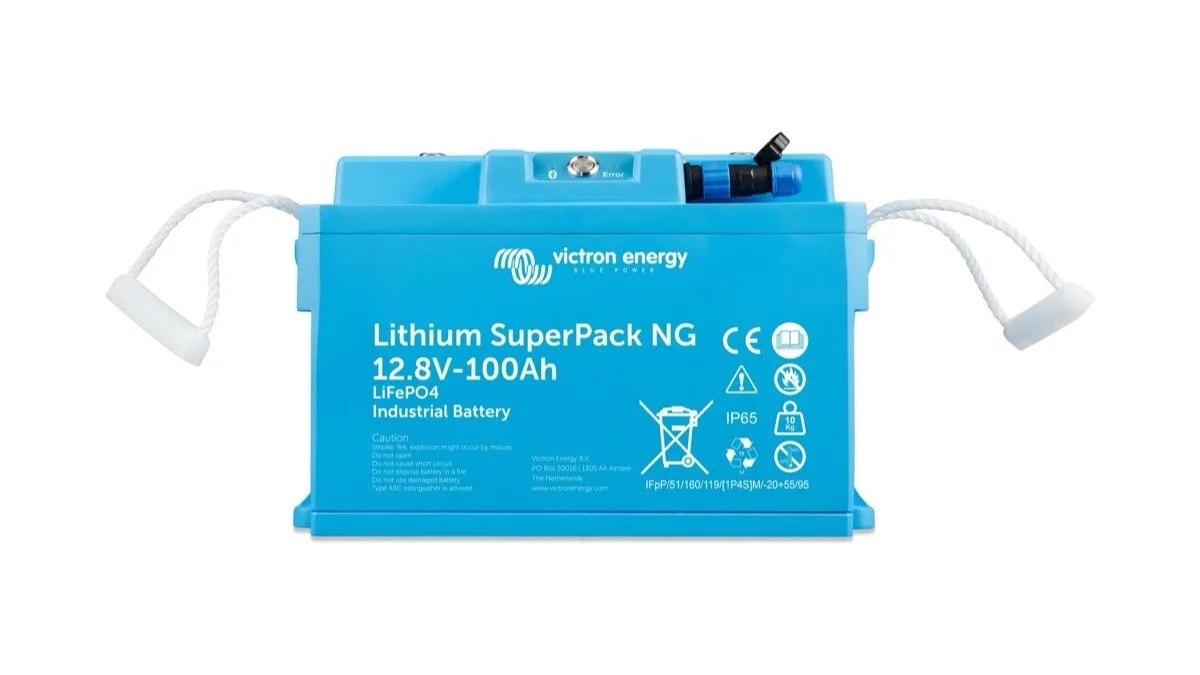
Home / Articles / LiFePO4 vs Lithium-Ion: What Boat Owners Should Know Before Upgrading
LiFePO4 vs lithium-ion batteries is not an either-or choice: lithium iron phosphate (LiFePO4, or LFP) is one chemistry inside the lithium-ion family, and ABYC's lithium standard E-13 covers it. Compared with NMC, LFP gives up some energy density for thermal stability and long cycle life, and most marine lithium battery makers have settled on it.
What is a LiFePO4 lithium battery?
A LiFePO4 lithium battery is a lithium-ion battery whose cells use lithium iron phosphate, a phosphate-based chemistry known for thermal stability, long cycle life and predictable performance.
PNNL describes lithium-ion as a family of chemistries built on reactions between a lithiated metal oxide cathode and a graphite anode, with NMC and LFP among the most common. The four widely used types are LFP, NMC (nickel manganese cobalt), NCA (nickel cobalt aluminum) and LCO (lithium cobalt oxide).
How is LiFePO4 different from NMC lithium-ion?
NMC stores more energy in less space, while LiFePO4 gives up some energy density in exchange for thermal stability and long cycle life.
The U.S. Department of Energy says NMC and LFP dominate lithium-ion, NMC for energy density and LFP for safety characteristics. Despite lower energy density, Boating Magazine puts a lithium marine battery at one-third to one-half the weight of lead-acid for the same energy. Victron gives round-trip efficiency (a full discharge and recharge) of about 92% for LFP against about 80% for average lead-acid.
| LiFePO4 (LFP) | NMC | |
|---|---|---|
| Design priority | Thermal stability, cycle life, predictable performance | Very high energy density |
| Energy density | Lower | Higher |
| Thermal runaway | Less prone than most other lithium-ion types under normal conditions, per Battle Born | Releases oxygen during runaway, which feeds the fire |
| Typical use | Marine deep-cycle drop-in batteries | Electric vehicles and weight-critical uses |
| Share of battery-powered vessels, mostly commercial (DNV 2025, at the time of writing) | 12% | 79% |
Why are marine drop-in batteries almost all LiFePO4?
Marine drop-in batteries are mostly LiFePO4 partly because a four-cell LFP battery closely matches lead-acid voltage, and earlier cobalt and manganese formulas proved hazardous.
A single LFP cell has a nominal voltage of 3.2 V; four in series make a 12.8 V battery and eight make a 25.6 V battery. Battle Born says that match with lead-acid is part of why LiFePO4 is the most common marine deep-cycle lithium chemistry.
Sources differ on "nominal": Victron, Dakota Lithium and Lithionics use 12.8 V, while one Battle Born article applies the word to a higher figure that looks like resting voltage.
LiFePO4 also has a flatter discharge curve than lead-acid, holding a steady voltage through more of its usable capacity. BoatUS notes that lithium voltage stays nearly constant until the battery is almost empty and then drops quickly, so voltage alone is a poor state-of-charge indicator.
Is LiFePO4 safer than lithium-ion types like NMC?
LiFePO4 is described as the more thermally stable choice: Victron calls it the safest mainstream lithium type, and BoatUS called it the safest available chemistry in 2023.
Battle Born says LiFePO4 is less prone to thermal runaway than most other lithium-ion chemistries under normal operating conditions. Thermal runaway starts when an internal exothermic reaction produces heat faster than the cell can shed it. The Coast Guard R&D Center lists physical, electrical or thermal abuse, manufacturing defects and aging as causes, with immediate or delayed onset.
Safer does not mean harmless. In studies cited by the Coast Guard R&D Center, lithium-ion fires produced hydrogen fluoride and carbon monoxide at levels immediately dangerous to life or health regardless of chemistry.
- Extinguishers: BoatUS wrote that a conventional marine-approved extinguisher cannot put out a thermal-runaway fire, and that no lithium-specific extinguisher had Coast Guard approval at that writing.
- Suppression: The Coast Guard R&D Center recommends large amounts of water, water spray or foam; gaseous and dry-powder agents lack the cooling to stop reignition.
Main-bank overcurrent protection is covered in our guide to Class T fuses for lithium banks.
How long do LiFePO4 batteries last?
LiFePO4 life is rated in charge cycles, and the count depends on depth of discharge, the share of capacity used before recharging.
At the time of writing, Victron rates its Lithium Smart batteries to keep at least 80% of nominal capacity for 2,500 cycles at 80% depth of discharge, 3,000 at 70% and 5,000 at 50%. Its datasheet rates capacity loss at under 1% per 100 cycles at 25°C (77°F) and 100% depth of discharge.
LFP does not need regular full charges, and Victron says its life even improves slightly with partial charging. In years, battery maker Battle Born says a quality lithium marine battery can typically last a decade or more, its own general claim with no test conditions given.
How to charge a LiFePO4 battery
Charge a LiFePO4 battery on a profile set to its maker's own voltages, with equalization and temperature compensation turned off.
Sources differ on absorption voltage, so use your maker's figures, in this order:
- Find the maker's settings. At the time of writing, Victron recommends 14.2 V absorption for 2 hours and 13.5 V float for its 12.8 V batteries. Battle Born suggests 14.2–14.6 V absorption, 30 minutes per battery and 13.4–13.8 V float. Lithionics specifies 14.4 V ±0.2 V charge and 13.6 V ±0.2 V float for its 12 V 205 Ah battery.
- Program every charger that feeds the bank to those figures.
- Turn off equalization. Battle Born says to disable it if possible, and Dakota Lithium says its LiFePO4 battery needs no equalizing.
- Disable temperature compensation or set it to 0 mV/°C, as Victron advises.
- Set any storage mode equal to float if the charger has one.
- Set the charge current. Victron recommends 0.5C, or 50 A for a 100 Ah battery, which fully recharges an empty battery in about 2 hours.
- Check the temperature before charging in the cold. Sources differ: Victron says a cell is permanently damaged if charged below 5°C (41°F), while Lithionics lists charging from 32°F (0°C). Charging in extreme cold can cause lithium plating, which can lead to internal short circuits.
How should you store a LiFePO4 battery over the off-season?
Store a LiFePO4 battery disconnected, because alarms, relays and charger back-drain can slowly over-discharge and damage a connected battery.
Sources differ on storage state of charge. Battle Born's procedure is a full charge, then disconnection, and it says its batteries lose about 2–3% per month, leaving roughly 75–80% after six months. For storage over a month, Lithionics recommends charging to 100% to calibrate, discharging to 50–80%, then powering the battery off. Battle Born's own pages also differ on its low-temperature storage limit, so confirm it with the maker.
What does a BMS protect against?
A battery management system (BMS) is a lithium battery's control electronics, typically guarding against overcharge, over-discharge, overcurrent and short circuits.
A BMS also blocks charging or discharging outside safe temperatures and balances cells so no single cell becomes the weak link. At the time of writing, Victron's BMS stops charging above 3.75 V per cell and disconnects loads when a cell falls below 2.8 V.
Victron says to recharge immediately after a low-cell-voltage shutdown, because small parasitic loads can then damage the battery within days. Victron also warns that a battery charged after falling below its cut-off voltage, or when damaged or overcharged, can release a harmful mixture of gases, so have such a battery checked first.
What to check before you buy
A LiFePO4 purchase starts with the datasheet and your chargers.
- LFP or LiFePO4 on the label, with 3.2 V cells in a 12.8 V or 25.6 V battery.
- The maker's absorption and float settings, and whether each charger can match them.
- Chargers that can disable equalization and temperature compensation.
- The lowest charging temperature and how the BMS blocks cold charging.
- The cycle rating and the depth of discharge behind it.
- Cable size, lug condition, torque and corrosion at the terminals, where Battle Born says most incidents start, not inside the cell.
Bank sizing is covered in our lithium marine battery buying guide, and current options are on the eMarine batteries page.
Common mistakes when switching to LiFePO4
Most LiFePO4 mistakes carry lead-acid habits into a lithium system.
- Leaving a charger on a lead-acid profile with equalization or temperature compensation active.
- Judging state of charge from a voltmeter.
- Charging in the cold without checking the maker's limit.
- Leaving the battery connected to standby loads over the off-season.
- Treating LFP as fireproof or counting on a conventional extinguisher.
What can you do yourself, and when do you need a marine electrician?
A boat owner can compare datasheets, program a charger, inspect terminals and follow the storage procedure; new cabling, fusing and charging sources call for a marine electrician.
Resizing cable, adding a main fuse, integrating an inverter-charger or chasing repeated BMS shutdowns belong with a professional, because Battle Born says connections, cabling and charger setup are where most incidents start. Series trolling motor banks are covered in our guide to lithium trolling motor batteries.
How eMarine Systems can help
eMarine Systems plans and installs LiFePO4 upgrades, with dockside service at marinas across Miami-Dade, Broward and Palm Beach counties.
The company was founded in 1999 by former NASA engineers Joe Turner and Gary Chapman and started with onboard power systems. eMarine Systems is an ABYC member.
Each lithium boat battery upgrade includes a power demand analysis, system sizing and component matching, and compatibility verification before work begins, with technical support after commissioning. For a like-for-like swap, see boat battery replacement. eMarine works with Victron among other brands, and charger setup falls under Victron and Mastervolt installation.
eMarine does not publish installation prices; cost is quoted after an onboard inspection. eMarine does not do hull, fiberglass, engine mechanical or propeller work. Call (954) 520-2055.
Frequently asked questions
Are LiFePO4 and lithium-ion batteries the same thing?
LiFePO4 is a type of lithium-ion battery, not a separate category. ABYC's lithium standard E-13 applies to LFP like any other lithium-ion type.
Is LiFePO4 safer than lithium-ion types like NMC?
LiFePO4 is described as safer: Battle Born says it is less prone to thermal runaway under normal conditions. In studies cited by the Coast Guard R&D Center, lithium-ion fires still produced dangerous hydrogen fluoride and carbon monoxide regardless of chemistry.
How long do LiFePO4 batteries last?
At the time of writing, Victron rates its LiFePO4 batteries at 2,500 cycles at 80% depth of discharge up to 5,000 at 50%. Battery maker Battle Born says a quality lithium marine battery can last a decade or more, its own claim without stated test conditions.
Can I charge a LiFePO4 battery with my old lead-acid charger?
Only if the charger can be set to the battery maker's absorption and float voltages, with equalization and temperature compensation off. Makers' figures differ, such as 14.2 V from Victron and 14.4 V ±0.2 V from Lithionics.
Do I need to fully charge a LiFePO4 battery after every trip?
No, LFP does not need to be fully charged regularly the way lead-acid does. Victron says its service life even improves slightly with partial charging.