
Home / Articles / Marine Inverter Chargers Compared: Victron MultiPlus-II vs Magnum vs Xantrex Freedom
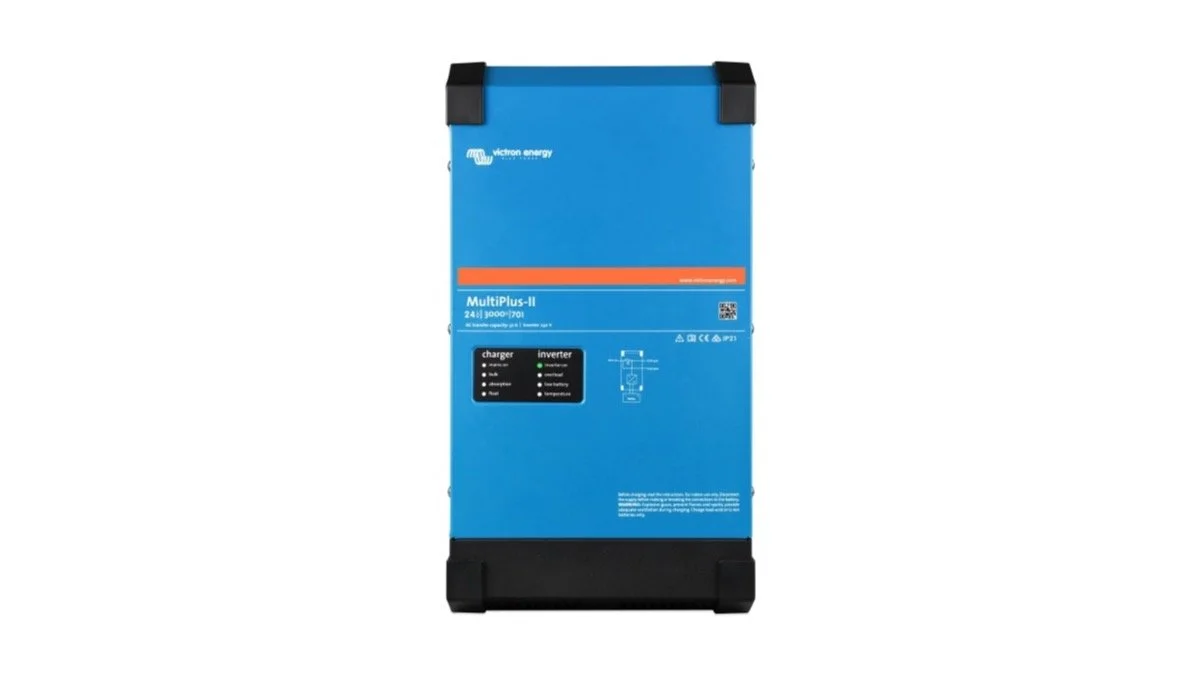
The Victron MultiPlus-II, Magnum MS and Xantrex Freedom XC PRO Marine are combined inverter/chargers: each turns battery power into 120 V AC, charges the batteries from shore or generator power, and passes that power through to the boat. They differ in output, charger current, transfer relay rating and shore-power features.
What is an inverter charger on a boat?
An inverter charger is one box that does three jobs: inverting battery DC to AC, charging the batteries from AC, and switching the boat's AC loads between sources.
An inverter on a boat converts battery DC, typically 12 V, into 120 V AC. On shore or generator power, a Magnum inverter/charger charges the batteries while its internal transfer relay passes the incoming AC straight to the loads. That relay's amp rating is a key difference between brands.
Pure sine wave vs modified sine wave: which does a boat need?
A pure sine wave inverter makes AC shaped like shore power, while a modified sine wave inverter makes a stepped wave that can upset onboard electronics.
West Marine says a good pure sine inverter has under 5% total harmonic distortion, typically about 2%, versus 20–25% for modified sine. BoatUS says modified sine can cause buzzing in radios, lighting and audio gear, distortion on some TVs, and computer issues. Magnum says motors run cooler on pure sine and microwaves usually cook faster. Xantrex calls the Freedom XC PRO Marine true sine wave.
Sources differ on motors: Xantrex's Tech Doctor says modified sine inverters have the advantage with simple motor or resistive loads, while West Marine says pumps and refrigerator compressors typically use more power on modified sine.
Victron MultiPlus-II, Quattro, Magnum and Xantrex Freedom compared
The three brands overlap at roughly 2000–3000 W continuous but differ in charger current, relay rating and the temperature behind each rating.
All rows are 12 V models, as listed at the time of writing.
| Model | Continuous output | Surge / peak | Max charge current | Transfer relay |
|---|---|---|---|---|
| Victron MultiPlus-II 12/3000/120 | 2400 W at 25°C, 2200 W at 40°C | 5500 W | 120 A | 50 A |
| Victron MultiPlus-II 12/4k/160 | 3.4 kW at 25°C, 3.1 kW at 40°C | 6 kW for 2 s | 160 A | 50 A |
| Victron Quattro 12/5000/220 | 4000 W at 25°C, 3700 W at 40°C | 10000 W | 200 A plus 4 A starter | 2x 100 A feed-through |
| Magnum MS2012 | 2000 W | 3300 W | 100 A | 60 A |
| Magnum MMS1012 | 1000 W | 1750 W | 50 A (MMS1012-L) | 20 A |
| Xantrex XC PRO Marine 2000 | 2000 W at 40°C | 4000 W up to 5 s | 100 A | 24 A cont. |
| Xantrex XC PRO Marine 3000 | 3000 W at 40°C | 6000 W up to 5 s | 150 A | 40 A cont. |
Compare continuous ratings at the same temperature: Xantrex rates at 40°C, and Victron gives both 25°C and 40°C figures.
Victron MultiPlus-II and Quattro
The 120 V Victron MultiPlus-II also comes in 24 V and 48 V versions, and the 5 kVA models have a 95 A transfer switch. It charges at up to 160 A (12/4k/160) and offers PowerAssist; its limit is lower continuous output at 40°C than at 25°C. Its manual requires external connections to meet U.S. Coast Guard rules, 33 CFR 183 Subpart I. The Victron Quattro adds two independent AC inputs and connects to the active one; at the time of writing it runs up to the 48/10000/140 at 8000 W at 25°C.
Magnum MS and MMS series
A Magnum MS inverter has 60 A transfer service on every model except the MS2000, at 30 A. The MS2812 is rated 2800 W with a 125 A charger, and the series is listed to UL 458. Limit: the lead-acid MS versions are marked Superseded at the time of writing, while lithium (-L) versions with the same power figures are listed.
Xantrex Freedom XC and XC PRO Marine
The Xantrex Freedom XC PRO Marine is listed to UL458 and its Marine Supplement (drip shield 808-1050 required) and to ABYC E-11 and A-31. It supports NMEA 2000, J1939, lithium charging and ignition control; its limit is a transfer relay rated 24 A or 40 A continuous, below the MultiPlus-II and MS figures. The non-PRO Freedom XC includes a 24 V 2000 W/40 A model.
Features to compare beyond watts
Beyond watts, compare how each unit handles a small shore breaker, lithium charge profiles and remote monitoring.
Shore power boost. Victron PowerAssist lets a 3 kVA MultiPlus-II add up to 3 kVA (25 A at 120 V) from the battery during peak demand, on top of shore or generator input. Xantrex Power Share instead reduces charge current to keep total AC input below the shore breaker setting.
Lithium profiles. VEConfigure sets the MultiPlus-II charge algorithm for any battery type, including lithium-ion. Magnum's LFP profile is selected only with the ME-RC or ME-MR remote. On the Freedom XC PRO, select LFP only for a lithium iron phosphate battery whose BMS is listed.
Monitoring. Victron's free VEConfigure software changes all MultiPlus-II settings from a PC, and Xantrex units use an app through the optional Freedom X Bluetooth remote panel. Victron displays are covered in our Victron Cerbo GX article, battery monitors in SmartShunt vs BMV-712.
How do you size a marine inverter for your boat?
Size a marine inverter by adding the watts of every appliance that will run at the same time, then checking surge and battery bank capacity.
Xantrex says motors and other inductive loads can draw as much as five times their rated power at start-up, so check surge figures as well as continuous output. An air conditioner compressor is one such load; see boat air conditioner options.
Sources differ on a safety margin: Xantrex's Tech Doctor adds a fixed percentage on top of loads that may run together, while BoatUS takes simultaneous watts plus any surge as the minimum continuous rating, with no fixed margin.
BoatUS says the battery bank should be at least 20% of the inverter's watt rating in amp-hours, for example 400 Ah for a 2,000 W inverter. For the MultiPlus-II 12/3000/120, Victron specifies a 400–1200 Ah battery.
How to choose and plan an inverter charger installation
An inverter charger installation follows this order, from loads to configuration.
- Add the watts of loads that run together and compare motor start-up draw with surge ratings.
- Check the bank against the 20% amp-hour rule.
- Compare the transfer relay rating with the AC the unit will pass through.
- Pick a separate, ventilated compartment away from the battery and outside any gasoline engine compartment.
- Size DC cable and fuse from the maker's table.
- Before AC wiring, disconnect DC power and the inverter from the AC system and post a warning at the main AC panel.
- Wire AC so neutral and ground are not bonded on the boat on shore power.
- Set the battery type in VEConfigure, a Magnum remote or the Xantrex app.
Installation essentials: DC cable, fuse, grounding and ventilation
The manuals and BoatUS call for heavy DC cable, a DC fuse close to the battery, neutral-ground bonding only when inverting and a ventilated location away from the batteries.
Victron specifies a 400 A DC fuse and 2x 1/0 AWG per terminal up to 5 m for the MultiPlus-II 12/3000/120. Xantrex requires 2/0 AWG with a maximum 250 A fuse for the XC PRO 2000 and 4/0 AWG with 350 A for the 3000, under 5 ft. BoatUS says ABYC calls for the DC fuse within 7 inches of the battery, and Class T rather than ANL. Inadequate wiring at these currents risks shorts and fires.
Grounding sources differ: BoatUS says the chassis ground must equal the DC positive conductor in size, while Magnum says some marine installations call for a DC ground the same size as or one size smaller than the negative cable.
The MultiPlus-II and Magnum MS both bond output neutral to ground through an internal relay only when inverting. Connecting directly to shore ground risks galvanic corrosion, and Victron recommends an isolation transformer; see galvanic isolator vs isolation transformer.
Never place the unit directly above the battery, where gases damage it, or in a gasoline engine compartment, because inverters are not ignition-protected.
What to check before you buy
Before buying, confirm these inverter charger points against the datasheet and the boat.
- Continuous output at 40°C if the compartment runs warm.
- Transfer relay rating against the AC passed through.
- The remote or software needed for a lithium profile.
- Marine listings you need, such as the UL458 Marine Supplement.
Common mistakes with marine inverter chargers
Common inverter charger mistakes involve location, fusing, neutral bonding and charge settings.
- Mounting the unit above the battery or in a gasoline engine compartment.
- Using an ANL fuse where BoatUS, citing ABYC, calls for Class T.
- Sizing for running watts and ignoring motor start-up draw.
- Bonding neutral to ground on the boat on shore power.
- Selecting LFP on the Freedom XC PRO without a listed BMS.
What can an owner do alone, and when do you need a marine electrician?
An owner can list loads, check bank size and choose charge settings; DC cabling, fusing and AC wiring belong with a marine electrician because of fire and shock risk.
Inverter AC is as dangerous as household AC, and West Marine recommends professional installation because of the high currents. Neutral bonding and isolation transformer work belong with an electrician too.
How eMarine Systems can help
eMarine Systems started with onboard power, including batteries, inverters and chargers, and is an ABYC member in Fort Lauderdale.
Our inverter and charger installation work begins with a power demand analysis, system sizing and compatibility checks. Victron systems are covered by our Victron installer service, and shore inlets and converters by shore power repair. Dockside service covers Miami-Dade, Broward and Palm Beach counties.
If an old unit fails, eMarine tests and repairs Xantrex and Magnum inverters in-house at its Fort Lauderdale facility, so the repair-or-replace choice starts from a test result.
DIY owners can browse Victron Energy products, Magnum inverter chargers, Xantrex inverter chargers and other marine inverters in our online store. Installation is quoted after an onboard inspection; call (954) 520-2055.
Frequently asked questions
What is the difference between the Victron MultiPlus and MultiPlus-II?
Victron says the MultiPlus-II has all the features of the MultiPlus plus an external current sensor option. That sensor extends PowerControl and PowerAssist to 100 A.
When does a Victron Quattro make sense instead of a MultiPlus-II?
A Victron Quattro makes sense when the boat has two AC sources, such as shore power and a generator, because it accepts both and connects to the active one.
Can a marine inverter charger charge lithium batteries?
Yes, all three brands offer a lithium setting, each with a condition. Victron sets it in VEConfigure, Magnum needs the ME-RC or ME-MR remote, and Xantrex allows LFP only with a listed BMS.
Is an old Magnum or Xantrex inverter worth repairing?
That depends on what a test of the unit finds. eMarine tests and repairs Xantrex and Magnum inverters in-house at its Fort Lauderdale facility.
Can an inverter charger go in the engine room?
No, not in a gasoline engine compartment, because inverters are not ignition-protected; Magnum states this for the MS Series. Victron calls for a separate, well-ventilated compartment away from the battery.