
Home / Articles / Boat Air Conditioner Options: Self-Contained, Portable, 12V and Hatch Units
A marine air conditioner cools a boat by moving cabin heat into seawater: a pump draws water through a thru-hull, past the condenser and back overboard. The main options are self-contained, split, chilled-water, 12 V DC and hatch units, run from shore power, a generator or a large inverter and battery bank.
How does a marine air conditioner work?
A marine air conditioner uses a refrigerant loop to pick up cabin heat and a seawater circuit to carry it overboard.
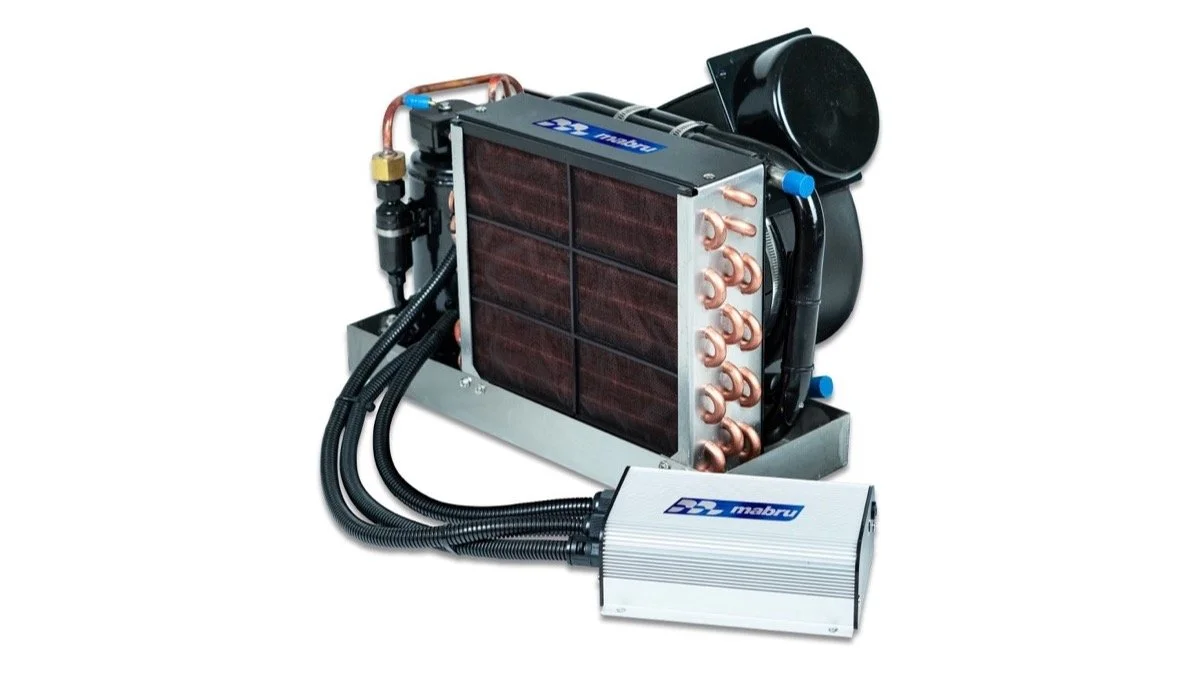
In the evaporator refrigerant absorbs heat from cabin air, the compressor pushes it through the system, and the condenser cools it. On a boat the condenser is water-cooled, with a dedicated intake thru-hull and seacock, a strainer, a centrifugal pump and an overboard discharge thru-hull. Centrifugal pumps are not self-priming and must be mounted below the waterline. West Marine's rule of thumb is 180 gallons per hour (3 gpm) of seawater per ton, where one ton is 12,000 Btu/hr.
Reverse-cycle units heat by pulling heat out of the seawater; West Marine says they cool in 90°F water and heat in water as low as 40°F. Most systems have a safety switch that stops the compressor when cooling-water flow is too low.
What types of boat AC units are there?
Boat AC units come in five main types, each with its own space, noise and power trade-offs.
| Type | Where it fits | Strengths | Limits |
|---|---|---|---|
| Self-contained | Boats up to 40 ft, per West Marine | All parts on one chassis in the living area | Compressor sits in the living area |
| Split (central) | Boats up to 80 ft | Dometic's split-gas keeps compressor noise in the engine room | Two separate units to install |
| Chilled water | Engine-room chiller with cabin air handlers | One chiller serves several living spaces | Insulated water loop through the boat |
| 12 V DC | Smaller units, per BoatUS | Runs directly from the battery bank | A 10,000 BTU unit can draw over 50 A |
| Hatch-mounted | Dockside living | Temporary option, per Practical Sailor | Leaks in squalls, most drip condensation |
Self-contained units
At the time of writing, Dometic GT units come in 6,000, 10,000 and 16,000 BTU/h sizes and Webasto BlueCool S-Series in seven sizes, all with reverse-cycle heating.
Split and chilled-water systems
A split system divides the components between two units. Dometic says its split-gas system keeps compressor noise in the engine room, with quiet evaporators in living areas. A chilled-water system pumps fresh water from an engine-room chiller to air handlers. At the time of writing, Uflex's Velair range covers self-contained and chiller systems from 4,000 to 62,000 BTU/h, with variable-speed drive.
12V DC and engine-driven units
BoatUS says high-efficiency DC units let boaters run A/C directly from the battery bank, but high amperage generally limits 12 V to smaller units. At the time of writing, Breeze by Webasto instead uses an engine-driven compressor, a seawater pump and an evaporator on a 12 V supply, so it needs no generator.
Hatch-mounted and portable units
A hatch-mounted unit is a good temporary solution for dockside living, says Practical Sailor, but it leaks rainwater in squalls however well fitted. Practical Sailor also advises avoiding single-hose household portables, which draw cooling air only from inside and can lose as much as 50% of cooling efficiency. A heavy hatch unit is dangerous to carry along side decks and must be well secured when stowed.
How do you size a marine air conditioner?
Marine air conditioner sizing uses cabin volume or floor area, adjusted for climate and glass, but the published rules of thumb differ widely.
Sources differ by about sixfold on BTU per cubic foot. BoatUS gives a general rule of at least 100 BTU per cubic foot. Practical Sailor's rough rule is 14–19 BTU per cubic foot, higher for warm climates, less insulation and more windows. Webasto uses 400 BTU/h per m³ for cabins all below deck with portlights only and 500 BTU/h per m³ for cabins partly below deck with average glass.
Sources also differ on furniture: Webasto's example subtracts 20% of a 50 m³ room for furniture to get 40 m³, while BoatUS says not to subtract furniture or equipment. West Marine uses floor area instead, with load factors from 60 Btu per sq ft below deck in a moderate climate to 150 above deck in the tropics. Because the methods disagree, follow the sizing guidance of your unit's maker.
Dark hulls in blue, black, green or red get considerably hotter than white ones and often demand much more from the A/C. Oversizing is no fix: Practical Sailor says it adds weight, noise, lost storage, power demand and expense, and dehumidifies less efficiently.
Can you run a boat air conditioner on batteries?
You can run a boat air conditioner on batteries with a DC unit or a sizable inverter and battery bank, plus a plan for starting current.
At the dock, West Marine says a 5,000–16,000 Btu AC-powered system draws about 4–13 A; under sail or at anchor it needs a sizable inverter and battery bank, or a generator. At the time of writing, the Dometic GT6 at 115 V needs circuit protection of minimum 11 A and maximum 15 A.
Practical Sailor says most A/Cs need much higher starting current than running current, so a traditional unit on an inverter typically needs a soft-start device. Figures for one model differ: Webasto lists the FCF Platinum 16,000 BTU/h at 11.2 A running and 60 A locked-rotor at 115 V, while Practical Sailor's table lists a slightly lower startup figure.
Dometic says its SmartStart III soft starter reduces startup amps by up to 65% and helps at marinas with weak circuit protection. BoatUS says variable-speed compressors start with a lower surge and reduce nuisance breaker tripping. Sources differ on their energy savings: BoatUS credits DC variable-speed units with higher efficiency, while Practical Sailor says they do not automatically save power because they run more often.
For battery size, Practical Sailor's 16,000 BTU test recommends at least 600 Ah of LiFePO4, 800 Ah or more preferred, and double for lead-acid. Our marine inverter charger comparison covers the inverter side.
What to check before you buy
Before buying, confirm these marine air conditioner points on the boat and in the maker's manual.
- A mounting space low in the boat and near centerline.
- A duct path within the typical 15 ft maximum, shorter with many bends.
- Room for a thru-hull, strainer and a pump below the waterline.
- A dedicated, adequately sized power circuit, as Velair requires.
- The seawater temperature behind the capacity rating; Dometic uses 85°F.
- Starting current and soft-start options if you will use an inverter.
How to plan a marine air conditioner installation
A marine air conditioner installation follows this order, from placement to commissioning.
- Place the unit low, under a bunk or in a locker, close to centerline to cut noise and trim issues.
- Plan the intake thru-hull with seacock, strainer, pump and overboard discharge.
- Mount the pump below the waterline; Velair requires at least 20 cm, on elastic supports.
- Slope the seawater circuit upward and put the discharge close to the waterline, per Velair.
- Double-clamp seawater hoses where the barb allows.
- Keep ducts within 15 ft and discharge air high, away from the return grille.
- Size the return inlet to the maker's minimum, never drawing from the bilge or engine space.
- Route the condensate; sources differ, with Velair allowing the bilge or a tank and BoatUS advising overboard or a pumped sump, not the bilge.
- Wire a dedicated circuit with protection called for by the maker and ABYC standards. Velair also requires a residual-current device and no extension cables.
- Commission the unit; Velair reserves commissioning and troubleshooting for its technical assistance centre.
Maintenance and winterizing the raw-water circuit
Marine air conditioner maintenance centers on the strainer, air filters and condenser coil, plus draining or flushing the raw-water side for winter.
Practical Sailor says an installed unit needs strainer cleaning every 8 to 100 hours, depending on sea grass and debris. BoatUS advises cleaning air filters monthly and flushing condenser coils with a weak biodegradable acid solution, typically every two to five years. Inspect seacock, pump and hoses for leaks, corroded clamps, chafe and cracks.
For winter, BoatUS drains the raw-water side from seacock through strainer to pump, then purges the rest with compressed air, or flushes it with antifreeze. Velair says to empty all circuits and the seawater condenser in cold periods. Close the A/C seacock whenever the system is not in use.
Common mistakes with boat air conditioning
Common boat A/C mistakes involve pump placement, return air, sizing and leaving the system running unattended.
- Mounting the centrifugal pump above the waterline.
- Drawing return air from the bilge or engine space.
- Oversizing the unit for extra margin.
- Running a traditional unit on an inverter without a soft start.
- Leaving the A/C on with nobody aboard: a failed raw-water hose can keep pumping seawater and sink the boat.
What can an owner do alone, and when do you need a marine technician?
An owner can clean strainers and filters and winterize the raw-water side; refrigerant work needs a technician.
Practical Sailor says DIY installation of a permanent unit is practical if you are prepared to run wiring and ductwork and install thru-hulls and plumbing. If refrigerant or oil leaks, disconnect power to the unit and seawater pump, close the water taps and call a refrigeration technician; do not release refrigerant into the air.
How eMarine Systems can help
eMarine Systems works dockside across Miami-Dade, Broward and Palm Beach counties, and each project starts with a power demand analysis and compatibility checks.
For units that fail to cool or trip breakers, see our marine air conditioning repair service. Shore inlets and dock circuits fall under shore power repair, and generators under marine generator repair. eMarine is an ABYC member. Shore power also affects corrosion; see galvanic isolator vs isolation transformer.
DIY owners can browse marine air conditioners in our online store. eMarine does not do hull or fiberglass work, which matters if a new thru-hull is needed. Installation is quoted after an onboard inspection; call (954) 520-2055.
Frequently asked questions
Can a marine air conditioner heat the boat?
Yes, if it is reverse-cycle: it pulls heat out of the seawater, and West Marine says it can heat in water as low as 40°F.
What seawater temperature are Dometic marine air conditioner ratings based on?
Dometic bases all its capacity ratings on 85°F (29.5°C) seawater. Dometic advises checking which seawater temperature any maker uses, because warmer water lowers performance.
Is a hatch unit louder than an installed boat AC unit?
In Practical Sailor's test, yes: an installed Dometic Turbo measured 67 dB versus 75 dB for a smaller hatch-mounted portable. A 10 dB difference is ten times the sound energy.
How often should the sea strainer be cleaned?
Practical Sailor says every 8 to 100 hours of running, depending on sea grass and debris. Close the seacock, clean the basket, then briefly open the seacock to check nothing is clogged ahead of it.
Does a soft starter work with every marine air conditioner?
No, Micro-Air says its EasyStart Breeze fits nearly all marine systems, not all. On 220–240 V Cruisair SMX controls that switch the compressor with a triac, Micro-Air says the triac must be replaced with a relay when installing EasyStart.