
Home / Articles / DC-DC Chargers on a Boat: When You Need One and How to Size It
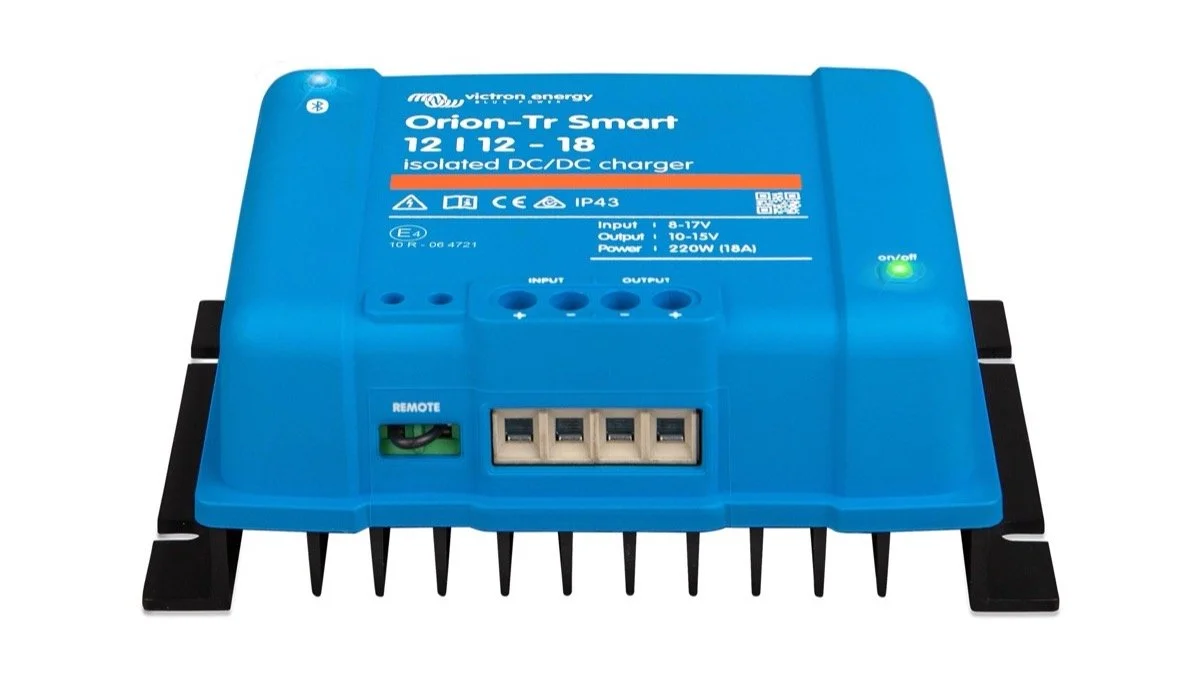
A Victron DC to DC charger such as the Orion-Tr Smart charges a house battery from the starter battery and alternator with a bulk, absorption and float profile. On lithium it also protects the alternator from overload. Common reasons to fit one are lithium charged by the engine, mixed bank voltages or long cable runs.
What does a DC-DC charger do on a boat?
A DC-DC charger takes power from the engine side of the boat and delivers a controlled charge to a second battery bank.
Where an automatic charging relay (ACR) simply parallels the two batteries, a DC-DC charger converts the current into a multistage profile suited to the battery chemistry. It also controls current: Victron says the Orion XS current never exceeds the value set by the user, even when input voltage is higher than output voltage.
Do I need a DC to DC charger for a lithium battery on a boat?
A lithium house bank charged by an engine alternator is the main case: Victron says controlled DC-DC charging protects the alternator from overload.
Lithium has very low internal resistance and accepts much higher charge current than lead-acid. Victron names two risks of direct alternator charging: overheating, and rectifier diodes failing from over-voltage after the battery management system (BMS) disconnects the battery. Battle Born warns that a BMS shutdown during alternator charging can severely damage the alternator and electrical system.
Other cases:
- Different chemistries or bank voltages, for example a 12 V house bank charging a 24 V windlass or thruster bank.
- Long cable runs, where voltage drop is common on boats.
- Smart alternators, which vary output voltage and shut down when not needed, and can supply too low a charging voltage.
Still choosing the battery? See our lithium marine battery guide.
DC-DC charger vs ACR, battery isolator and external regulator
A DC-DC charger shapes the charge for the target battery; an ACR or diode isolator passes alternator voltage through; an external regulator controls the alternator itself.
| Device | What it does | Strengths | Limits |
|---|---|---|---|
| DC-DC charger | Multistage, chemistry-specific profile | Protects the alternator from overload on lithium; separates house bank from alternator | Much slower and less efficient than direct regulated charging, says Battle Born |
| ACR / VSR / combiner | Parallels starting and house batteries | Simple sharing of engine charging | Cannot raise voltage to the target bank; not recommended with LiFePO4, says Boating Magazine |
| Diode isolator | One alternator charges two or more separate batteries | Batteries never connected | About 0.45 V drop at rated output on Victron's Schottky Argo isolators; batteries may not reach 100% |
| External regulator | Alternator charges the lithium bank directly | Faster and more efficient than a DC-DC charger, says Battle Born | Must be a high-quality regulator, says Battle Born |
Victron also lists a BMS with a current-limited alternator port, such as the Smart BMS CL 12/100. For two-bank layouts, see our dual battery setup article and the guide to boat battery switches.
Isolated vs non-isolated DC-DC charger: which do you need?
Victron's isolated Orion-Tr Smart lets the input and output have separate chassis grounds; choose an isolated model when your system needs that separation.
At the time of writing, the non-isolated Orion-Tr Smart covers 12 V or 24 V systems, the isolated version also covers 48 V, and both suit lead-acid and lithium. Sterling's manual, by contrast, says the Pro Batt Ultra should be installed with the negatives common.
Victron Orion-Tr Smart, Orion XS and Sterling ratings
Victron model names give input voltage, output voltage and output amps; Sterling battery-to-battery chargers are rated by maximum input current.
- Victron Orion-Tr Smart isolated. At the time of writing, the 220-280 W models are the 12/12-18 (220 W), 12/24-10 (240 W), 24/12-20 (240 W), 24/24-12 (280 W) and 48/12-20 (240 W).
- Victron Orion XS 12/12-50A. This 50 amp Victron charger has a 1-50 A current setting range and, at the time of writing, a 700 W continuous rating up to 40°C at 14 V, with 98.5% maximum efficiency.
- Sterling Pro Batt Ultra. A BB1230 is a 30 A input unit and delivers less than 30 A at its output. Sources differ on its switching points: the product page says on at 13.3 V, off at 13.0 V; the V71+ manual says on above 13.2 V, off below 13.0 V for more than 240 seconds.
How do you size a DC-DC charger for your alternator?
Compare the total input current of all chargers, plus other loads, with the alternator's continuous output at idle and at operating temperature.
Alternator output can drop to about 50% of its rating at idle, and a hot alternator delivers less. In a Victron owner story, a stock 14 V / 50 A Volvo Penta alternator was measurably overwhelmed supplying an Orion-Tr Smart 12/12-30.
Sources differ on headroom: Marine How To reports Sterling recommends an alternator at least 30% larger than the B2B unit, but itself recommends at least double the charger input for LiFePO4, such as 60 A for a 30 A unit. Victron's separate lithium rule is an alternator rated at least twice the battery capacity, such as 400 A for 200 Ah.
At the time of writing, Victron says an unlimited number of Orion-Tr Smart units can run in parallel for more output. Each unit draws its full input current regardless of what the alternator can supply, so paralleling can overload a small alternator.
How does a DC-DC charger know the engine is running?
The Orion-Tr Smart detects a running engine from alternator voltage, so it does not drain the starter battery when the alternator stops supplying power.
Conventional alternators hold a fixed voltage such as 14 V, while smart alternators vary between 12.5 V and 15 V on 12 V systems. A signal above 7 V on the L-pin overrides detection and turns charging on. Victron notes that taking that signal from the ignition switch lets the charger drain the starter battery with the ignition on and the engine off.
What to check before you buy
A DC-DC charger choice starts with numbers from your own boat.
- Alternator output at idle and when hot, not just the nameplate.
- Total input current of all planned chargers plus other loads.
- Voltages of both banks, including any 12 V to 24 V need.
- Whether the two sides need separate grounds.
- Cable length from starter battery to charger to house.
- A dry spot outside the engine compartment unless the charger is ignition-protected, with 10 cm free above and below for the Orion-Tr Smart.
How to install a DC-DC charger step by step
A DC-DC charger install follows the manual in this order.
- For the Orion-Tr Smart, mount the charger vertically on a non-flammable surface, terminals down, with 10 cm clearance above and below. Never mount it directly above a battery, because of battery gassing.
- Keep it out of the engine compartment unless ignition-protected; the Mastervolt Mac Plus 12/12-50 Boating Magazine installed is not.
- Size cables to the manual: for 12 V Orion-Tr Smart isolated models, 6 mm² at 0.5 m, 10 mm² at 1-2 m, 16 mm² at 5-10 m; for the Orion XS, 16 mm² (6 AWG) under 5 m, 21.2 mm² (4 AWG) for 5-10 m. Strands thicker than specified can overheat at the screw terminals and cause fire.
- Fit the fuses the manufacturer specifies at both ends: 60 A for 12 V Orion-Tr Smart isolated models, 60-70 A for the Orion XS. Marine How To, citing ABYC E-11, fuses both positives within 7 inches of each bank, at least 125% of the input rating.
- Make a low-impedance ground; on the Orion XS the lug must touch bare, paint-free metal.
- Check polarity with a meter before connecting. The Orion-Tr Smart is not protected against reverse polarity, and that damage cannot be repaired.
- Set the profile in VictronConnect. For Victron's 12.8 V lithium battery, use 14.2 V absorption (28.4 V on 24 V) and 2 hours; Orion lithium absorption time is fixed, 2 hours by default. For lead-acid, the Orion lengthens absorption automatically after a deep discharge.
- Start the engine, confirm charging begins, then stop it and confirm charging stops.
If the house bank still will not charge, see our guide to a boat battery not charging.
Common mistakes with DC-DC chargers
Avoid these DC-DC charger mistakes.
- Sizing to the alternator's cold nameplate instead of hot idle output.
- Paralleling chargers without adding up their input currents.
- Triggering charging from the ignition switch, which can drain the starter battery with the engine off.
- Using an ACR on a LiFePO4 house bank.
- Fusing only the starter side.
- Mounting a non-ignition-protected charger in the engine compartment.
What can you do yourself, and when do you need a marine electrician?
A boat owner can measure cable runs, choose a model and set the charge profile; careful owners can also mount and wire one using the manual's tables.
Bring in a marine electrician when the alternator's idle output is unknown, for parallel chargers, separate grounds, or an external regulator. Alternator faults belong with boat alternator repair.
How eMarine Systems can help
eMarine Systems started in 1999 with onboard power, including chargers and converters.
Each project begins with a power demand analysis, system sizing and compatibility verification, and support continues after commissioning. On a lithium boat battery upgrade, that means checking the alternator against the charger first. eMarine works with Victron among other brands through its Victron installation service, and is an ABYC member.
DIY installers can find DC-DC converters in the online store. Service is dockside across Miami-Dade, Broward and Palm Beach counties. eMarine does not do engine mechanical work, and cost is quoted after an onboard inspection; call (954) 520-2055.
Frequently asked questions
What alternator do I need for a 50 amp Victron DC to DC charger?
The alternator must cover the charger's input current at idle and when hot, plus other loads. Output can fall to about 50% of rating at idle.
What is an isolated Orion-Tr Smart DC-DC charger?
The isolated Orion-Tr Smart allows separate input and output chassis grounds. At the time of writing, it also covers 48 V systems, which the non-isolated version does not.
Can I use an ACR instead of a DC-DC charger for a lithium battery?
No, Boating Magazine says an ACR is not recommended with LiFePO4 because of high surface voltages while the engine runs or an AC charger is on. An ACR only parallels the batteries.
Can a DC-DC charger charge my starter battery from the lithium house bank?
Yes, Marine How To shows a Sterling BB1230 charging a start battery from the house bank. At the time of writing, the Orion XS emergency reverse charge runs 15 minutes, then pauses 5 minutes for engine starting.
What settings does a Victron Orion use for lithium?
For its 12.8 V lithium battery, Victron recommends 14.2 V absorption for 2 hours. Orion lithium absorption time is fixed, 2 hours by default.