
Home / Articles / Dual Battery Setup on a Boat: Switch, ACR or DC-DC Charger?
A dual battery boat setup keeps one battery for starting the engine and one for house loads, so a stereo left on at anchor does not drain the battery you need to start. Three common arrangements manage the pair: a 1-2-BOTH-OFF switch, a switch plus an automatic charging relay, or a DC-DC charger. The choice depends on battery chemistry and what you will remember to do.
Why do boats separate the starting battery from the house battery?
A separate starting battery stays isolated and charged while the house battery runs loads at anchor.
For a battery that will run electronics, BoatUS suggests a larger deep-cycle battery that still has enough amperage to start the engine. When the house battery is flat, start the engine from the start battery alone, not combined with the discharged one.
Sources disagree on small boats: Marine How To argues many smaller engines can crank from the house bank, while BoatUS favors an isolated start battery.
What are the three ways to switch and charge two batteries?
The three common arrangements are a manual 1-2-BOTH-OFF selector switch, a switch paired with an automatic charging relay (ACR), and a DC-DC charger.
1-2-BOTH-OFF selector switch
A 1-2-BOTH-OFF selector switch lets you use one battery, combine both, or disconnect both when shutting down the 12-volt system. As most builders wire it, the selected position decides both which bank supplies the loads and which bank the alternator charges.
You must remember to switch to bank 2 and charge it, and leaving the switch on BOTH can run both banks completely flat. Perko states that running on BOTH may not fully charge all batteries.
Sources differ on moving the switch underway. Perko says its make-before-break switches allow switching between 1, BOTH and 2 with the engine running. Marine How To warns that worn switches can become break-before-make, and advises against it unless the switch is tested periodically. To test, turn on incandescent cabin lights and slowly rotate the switch 1-BOTH-2; any flicker means replace it.
Never turn the switch through OFF with the engine running. Disconnecting the alternator from its load can cause a large voltage spike that often destroys its rectifier diodes and can damage electronics on the switch's common (C) post. Perko switches with an Alternator Field Disconnect protect non-unitized alternators from this mistake.
Switch plus automatic charging relay
An automatic charging relay (ACR) sends charging current to both batteries without anyone throwing a switch, and stops house loads from draining the starting battery.
In Boating Magazine's install of a Dual Circuit Plus switch with an SI-ACR, the switch stays on ON and the ACR manages charging underway and on a shore charger. COMBINE is used only to start from the house battery in an emergency, and OFF when leaving the boat.
A voltage sensing relay engages when the charging bank's voltage rises and isolates the banks when charging stops. Thresholds vary: BEP's DVSR engages at 13.4V and disengages below 12.8V; Victron's Cyrix-ct connects between 13 V and 13.8 V. Victron says its Cyrix relay combiners have virtually no voltage loss, but a combiner may fail to connect a large, deeply discharged bank.
DC-DC charger
A DC-DC charger converts alternator current into a multistage charge profile matched to the house battery's chemistry, instead of simply paralleling the two banks.
The alternator charges the start battery and the charger feeds the house bank from it, which isolates the house bank from the alternator but charges more slowly. The Mastervolt Mac Plus 12/12-50, for example, charges only when the start battery is at charging voltage, so it does not drain the start battery. That unit is not ignition-protected and must not go in an engine compartment.
How do a switch, an ACR and a DC-DC charger compare?
A selector switch depends on the owner, an ACR automates charging, and a DC-DC charger matches the charge to the house bank's chemistry.
| Arrangement | How the second battery charges | What the owner must remember | Main limit |
|---|---|---|---|
| 1-2-BOTH-OFF switch | Alternator charges whichever bank is selected | Switch to bank 2 to charge it; do not leave on BOTH | Both banks can go flat; BOTH may not fully charge |
| Switch plus ACR | Relay joins banks while charging, isolates them after | ON in normal use, COMBINE for emergency starts, OFF ashore | Not recommended with LiFePO4 by Boating Magazine |
| DC-DC charger | Charger feeds the house bank from the start battery | Lithium house bank still needs a lithium AC charger | Slower than direct charging |
Why use a DC-DC charger for a lithium house bank and a lead-acid start battery?
A DC-DC charger limits alternator current into a lithium bank and isolates it from the alternator, which protects the alternator.
Lithium batteries have low impedance, so they pull high alternator current. A drop-in lithium battery's internal battery management system (BMS) can also disconnect the battery from a running alternator, just like turning a switch through OFF. Battle Born warns that a BMS shutdown during alternator charging can severely damage the alternator and the boat's electrical system.
Boating Magazine, quoting Navico, says an ACR will not adequately charge a LiFePO4 house bank and can damage the alternator if the battery goes into protection mode. Battle Born recommends only an isolator or a DC-DC charger between lithium and lead-acid batteries. The question is not settled: Victron's Cyrix-Li-ct combiner joins the two only when Victron's VE.Bus BMS allows charging and it senses 13.4V or more. Never connect lithium and lead-acid batteries directly. For trolling motors, see lithium trolling motor batteries.
Can a boat motor charge two batteries at once?
A boat motor's alternator can charge two batteries at once through BOTH on a selector switch, an ACR, a diode isolator or a DC-DC charger.
A diode isolator lets one alternator charge two or more batteries without connecting them, so a drained accessory battery leaves the starter alone. The cost is voltage drop: Victron's Schottky-diode isolators lose about 0.3 V at low current and about 0.45 V at rated output. That lower charge voltage can keep batteries from reaching 100% and age them early.
The sources reviewed give no general rule on whether two batteries need a bigger alternator; a lithium bank does draw high alternator current, which is why its charging is controlled. If a battery is not charging at all, start with finding the charging fault.
What to check before you start
Before you start, confirm the batteries match and know which circuits stay live.
- Battery types: do not mix types, such as an AGM with a flooded battery.
- Age and size: OPTIMA discourages paralleling batteries unless they match in age, size and type, and says a bank should be replaced together. Mismatched batteries can leave one overcharged and another undercharged.
- Isolator sizing: eMarine's battery isolator guide asks how many alternators, how many alternator amps and how many batteries.
- Direct-wired loads: vital equipment such as bilge pumps must keep power whatever the switch position, so those wires stay live with the switch OFF.
- Location: never mount a battery directly above or below a fuel tank, fuel line connection or fuel filter, or directly below a charger or inverter.
How do you wire a dual battery setup on a boat?
A dual battery wiring diagram shows each battery with a fuse near its positive terminal, the switch or charging device, and loads that bypass the switch.
- Remove the battery cables from the battery terminals before installing the second battery or doing major DC work.
- Mount the new battery away from fuel components and from under a charger or inverter.
- Fit overcurrent protection on every positive conductor within 7 inches of the battery's positive terminal; Marine How To's summary of ABYC E-11 allows 40 or 72 inches in some cases for sheathed or enclosed conductors.
- Size each main battery fuse to protect the wire: know its ampacity and the bank's interrupt capacity (AIC), and size to at least 125% of expected continuous load.
- Wire the switch, ACR or DC-DC charger, with a fuse or breaker near each bank on a DC-DC charger's positive cables.
- Cover every positive terminal with a rubber boot, nonconductive cover or battery box lid.
- Reconnect and repeat the flicker test on the selector switch.
Common mistakes with dual battery wiring
Common dual battery mistakes involve switch habits and mismatched parts.
- Leaving a 1-2-BOTH switch on BOTH, which can flatten both banks.
- Turning the switch through OFF with the engine running.
- Paralleling batteries of different types or ages.
- Connecting a lithium house bank straight to a lead-acid start battery.
- Using a diode isolator without allowing for its voltage drop.
What can you do yourself, and when do you need a marine electrician?
An owner can check battery types and ages, test a selector switch for flicker, cover bare terminals, and note which loads bypass the switch.
A marine electrician is the better call for sizing fuses to ampacity and interrupt capacity, and for any lithium-to-lead-acid charging, where a BMS shutdown can damage the alternator.
How eMarine Systems can help
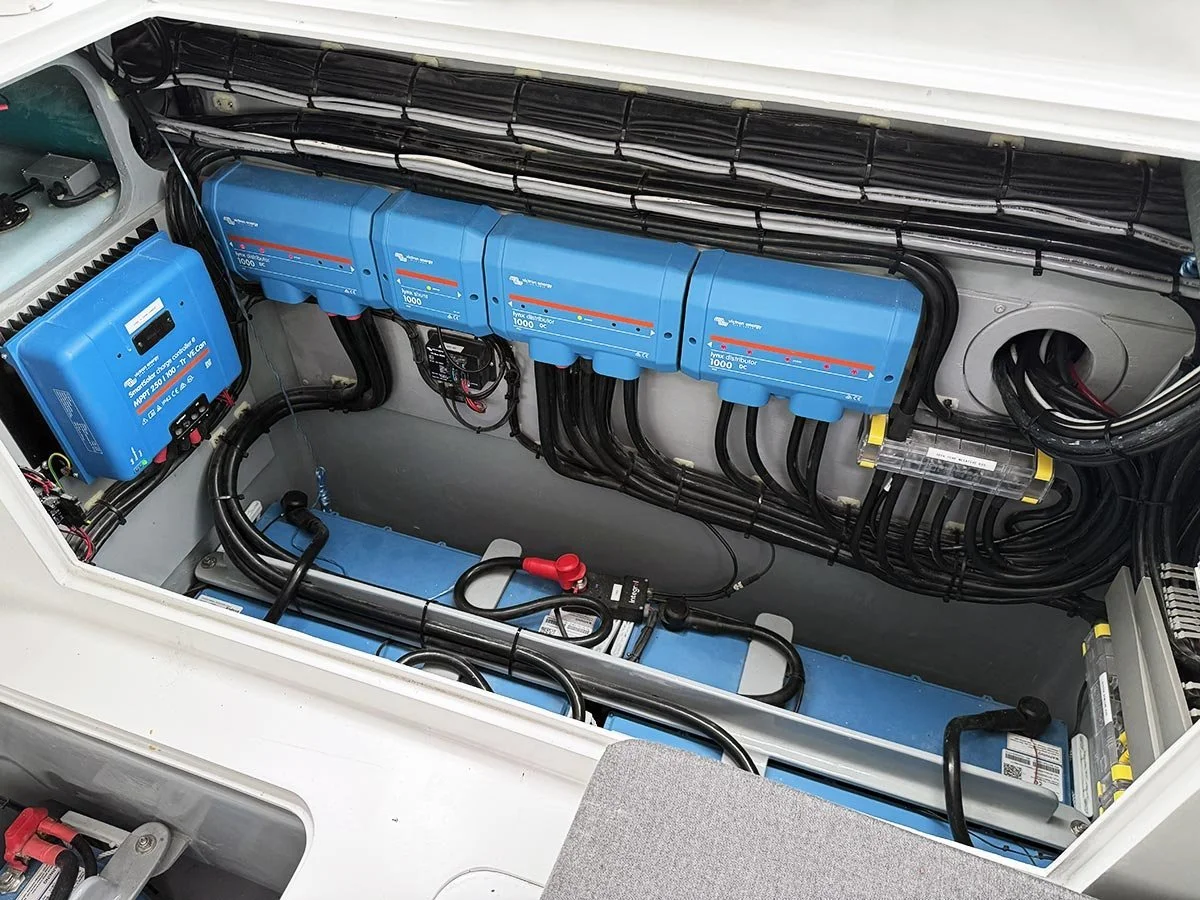
eMarine Systems started with onboard power, including batteries and chargers, and each project starts with a power demand analysis, system sizing, component matching and compatibility verification.
Related services are boat battery installation for the second battery, boat rewiring for fusing and cabling, and a lithium battery upgrade for a lithium house bank.
On a Hatteras 65 Convertible lithium upgrade, eMarine compared four- and eight-battery banks against an average load of about 4 to 4.5 kW and the owner's target of roughly 10 hours without the generator.
eMarine is an ABYC member and works dockside across Miami-Dade, Broward and Palm Beach counties. eMarine does not do engine mechanical work, and installation cost is quoted after an onboard inspection.
Frequently asked questions
Should I run two batteries in my boat?
Two batteries make sense if you run a stereo or electronics with the engine off, because a single battery can be drained and leave the engine unable to start. A separate house bank lets the start battery stay isolated and charged.
Can I use an ACR with a lithium house battery?
A standard ACR is not recommended with LiFePO4, according to Boating Magazine, because of high surface voltages when the engine or an AC charger is running. Victron does make a BMS-controlled lithium combiner, so the answer depends on the specific product.
Do I still need a shore charger with a DC-DC charger?
Yes, a lithium house bank still needs a lithium-specific AC charger even with a DC-DC charger, according to Navico's Craig Quentin. He advises against relying solely on a DC-DC charger for a LiFePO4 house bank.
Can I add a new battery next to an old one?
Adding a new battery to an old one in parallel is discouraged; OPTIMA advises against paralleling batteries unless they are identical in age, size and type. Batteries that charge at different rates leave one overcharged or undercharged.