
Home / Articles / Boat Battery Switches Explained: 1-2-Both, On/Off and ACR — Which One to Buy
A boat battery switch either disconnects one battery from its loads (on/off), lets you pick or combine two banks (1-2-Both), or keeps start and house banks on separate circuits (dual-circuit). For a second battery, a dual-circuit switch paired with an automatic charging relay (ACR) charges both banks without leaving them combined.
What types of marine battery switch are there?
The sources used here describe five marine battery switch designs: on/off disconnects, 1-2-Both selectors, dual-circuit switches, add-a-battery kits with an ACR, and remote-operated switches.
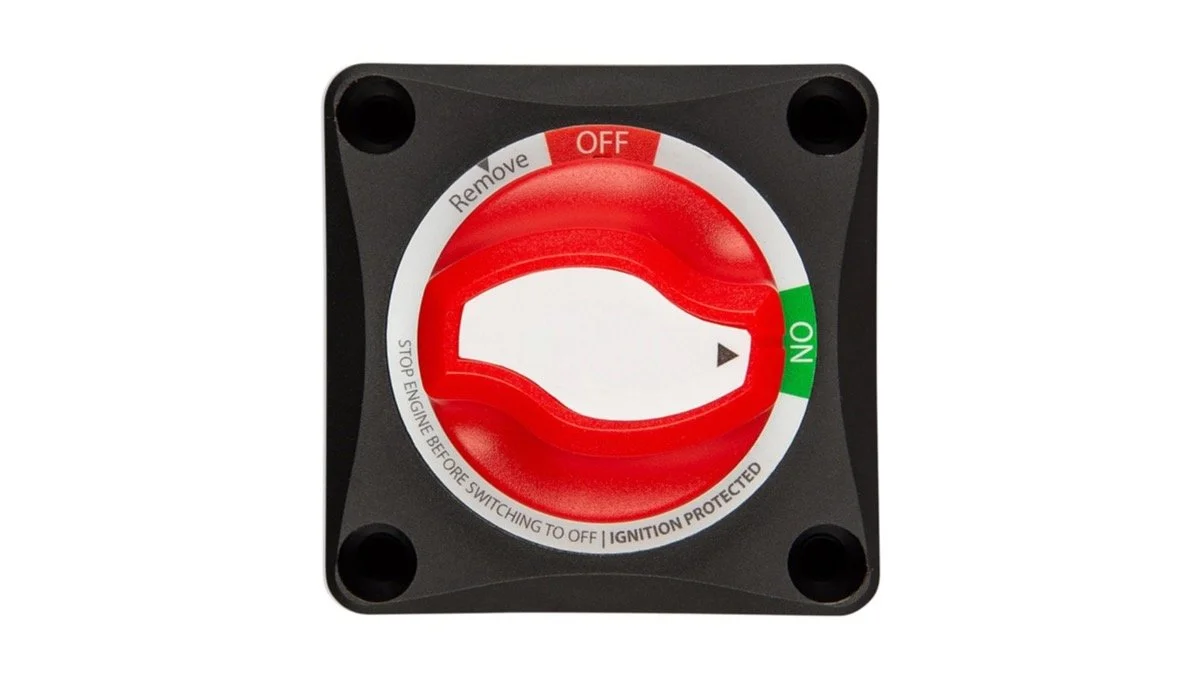
On/off disconnect. Blue Sea defines a single-circuit ON-OFF switch as one that switches a single battery to a single load group. BEP advises against its double-pole on/off switches for house and start together, so the house battery can keep powering communications when the engine battery is isolated.
1-2-Both selector. Blue Sea's 4-position selector (1, 2, 1+2, OFF) connects either bank to all loads or combines the banks. A selector cannot isolate circuits: house and start circuits are combined in the 1, 2 and BOTH positions.
Dual-circuit switch. A dual battery switch such as Blue Sea's Dual Circuit Plus is double-pole: on ON, the house battery feeds house circuits and the start battery feeds start loads. At the time of writing, BEP's Dual Bank Control switch combines House, Start and Emergency Parallel in one switch for one engine and two banks.
Add-a-battery kit. An ACR such as Blue Sea's SI-ACR is a relay that links two banks based on their voltage. At the time of writing, the SI-ACR in Blue Sea's Add-A-Battery kit combines batteries during charging, isolates them when discharging and starting, and supports alternators up to 120A.
Remote-operated switch. BEP's motor-driven switches can be installed very close to the battery and operated remotely.
| Switch type | Example ratings, at the time of writing | Limit to know |
|---|---|---|
| On/off disconnect | Blue Sea HD-Series 3000: 1,750A cranking, 900A intermittent | BEP advises against double-pole on/off for house and start together |
| 1-2-Both selector | Blue Sea 9001e: 1,200A cranking, 600A intermittent | Cannot keep start and house loads apart |
| Dual Circuit Plus | 700A cranking, 525A intermittent, 350A continuous per circuit | Designed to be used with an ACR |
| Add-A-Battery kit (SI-ACR) | Alternators up to 120A | ACR is not meant to carry starting current |
How do you read a battery switch's current ratings?
Blue Sea's 9001e instructions list three current ratings, each for a different length of time:
- Cranking: current for 30 seconds, what the starter asks for.
- Intermittent: current for 5 minutes, tested to UL 1107 on the Blue Sea 9001e.
- Continuous: current with no time limit.
At the time of writing, Blue Sea rates its m-Series at 300A continuous for outboards and small engines and its e-Series at 350A for inboards. BEP rates Pro Installer on/off and selector switches at 400A continuous, 600A intermittent and 1,500A cranking, at 48V DC for 12–48V systems.
Sources differ on some continuous ratings: Blue Sea's 9001e instructions say 350A, its product page 325A. The HD-Series 3000 instructions say 500A, Blue Sea's switch diagrams up to 600A. Perko's documents also disagree on its 9703 disconnect. Size to the lower figure.
Blue Sea's ratings assume one 4/0 AWG cable per terminal; smaller cable reduces them. See Blue Sea switches.
Why shouldn't you leave a 1-2-Both switch on BOTH?
A 1-2-Both switch left on BOTH puts both banks on all loads, and Marine How To reports owners running both dead, with no reserve to start.
Perko adds that BOTH may not fully recharge both; recharge on 1 or 2. Marine How To says most builders wire the alternator through the starter feed to the common "C" post, so the position decides which bank charges.
An ACR automates the choice. At the time of writing, Blue Sea's 12V SI-ACR combines at 13.6V after 30 seconds and opens at 12.75V after 30 seconds. For emergency starting, Blue Sea says to use the switch's COMBINE BATTERIES position, not the ACR. Relays are listed under battery isolators, and our dual battery setup guide compares a switch, an ACR and a DC-DC charger.
Can you turn a battery switch with the engine running?
Never turn a battery switch to OFF with the engine running; Blue Sea and Perko both say so. Marine How To explains that passing through OFF while charging disconnects the alternator from its load and can cause a voltage spike that often damages its rectifier diodes.
Sources differ on moving between 1, BOTH and 2 underway.
Perko says its selectors are make-before-break (the new contact closes before the old one opens), allowing 1-ALL-2 switching with the engine running. Marine How To cautions that switches can wear into break-before-make, so test yours: with incandescent cabin lights on, rotate 1-BOTH-2 slowly; any flicker means replace the switch.
Perko describes an Alternator Field Disconnect that breaks field current to protect the diodes if the switch is turned OFF with the engine running. If charging stopped afterward, see boat battery not charging.
Where should a battery switch go, and does its cable need a fuse?
Blue Sea quotes ABYC 11.7.1.2.2: a battery switch shall be mounted in a readily accessible location as close as practicable to the battery. Blue Sea also quotes ABYC 11.7.1.2.1, requiring a switch in the positive conductor from each battery or bank rated above 800A CCA.
On boats with gasoline engines other than outboards, 33 CFR 183.455 says every ungrounded current-carrying conductor, including the battery-to-switch cable, needs a manually reset, trip-free breaker or fuse; cranking motor power conductors are exempt. For a bank that may start a small diesel, Marine How To's bare-minimum fuse is 250A, preferably 300A.
On the same boats, 33 CFR 183.410 requires each electrical component not to ignite a 4.25–5.25% propane-air mixture around it. Perko says that if a switch is not plainly marked "Ignition Protected", assume it is not. At the time of writing, all BEP Pro Installer switches are ignition protected and IP66 rated.
Do lithium banks need a special battery switch?
We found no lithium-specific advice in Blue Sea, BEP or Perko switch documents; general guidance comes from BoatUS, Marine How To and Victron.
BoatUS, on ABYC E-13, says a lithium bank's main switch is an isolation switch, not the primary protection device; fuse choice is in Class T fuses for lithium. Victron warns that some battery switches cannot switch under load. Marine How To notes that a drop-in LiFePO4 battery's BMS can disconnect from a running alternator, like turning a 1-2-Both through OFF; see DC-DC chargers on a boat.
What to check before you buy
A boat battery switch must match the banks, the loads and its location.
- Cranking, intermittent and continuous ratings against your starter and house loads.
- Voltage rating against your system voltage.
- Cable size; Blue Sea's ratings assume 4/0 AWG.
- Whether start and house must stay apart, which a selector cannot do.
- An "Ignition Protected" marking; if it is not plainly marked, assume it is not.
- Which 24-hour circuits, such as the bilge pump, are wired directly to a battery.
How to wire a boat battery switch
A 1-2-Both battery switch is wired on the positive side only: battery positives go to input studs, and the output feeds the loads.
- Stop the engine and turn appliances off. Disconnect the positive battery terminal, as Blue Sea says; for its ML remote switch, all negative connections first.
- Mount the switch accessibly, as close as practicable to the batteries.
- Fit a manually reset, trip-free fuse or breaker on each battery-to-switch cable.
- On a 1-2-Both, run bank 1 positive to stud 1 and bank 2 positive to stud 2. On a Dual Circuit Plus, start battery to the start side, house battery to the house side. Never connect DC negative to a 1-2-Both switch.
- Connect the outputs: the "C" post feeds the starter and house, with the alternator usually returning through the starter feed.
- For an ACR, follow the kit's own diagram.
- Keep the bilge pump on the battery side of the switch.
- Reconnect, then run the cabin-light flicker test.
Common mistakes with boat battery switches
Most battery switch mistakes end in a dead start battery, a damaged alternator or a pump without power.
- Leaving a 1-2-Both on BOTH until both banks are dead.
- Turning the switch to OFF with the engine running.
- Connecting DC negative to a 1-2-Both switch.
- Wiring the bilge pump through the switch.
- Using a double-pole on/off for house and start together.
- Treating a lithium bank's switch as its overcurrent protection.
What can you do yourself, and when do you need a marine electrician?
A boat owner can test and exercise a switch; Perko's 9703 instructions say all wiring to the switch belongs to a qualified marine electrician.
On your own, run the flicker test. Perko says erratic operation after long idleness can be cleared by switching rapidly back and forth with no load connected.
Perko cites NFPA 302, ABYC and USCG standards, and Blue Sea says to consult a marine electrical professional for proper wiring, and adding a bank, an ACR, a remote switch or lithium is new wiring. Live 12V wires can remain with the switch OFF. A marine electrician in South Florida can trace them first.
How eMarine Systems can help
eMarine Systems handles boat battery replacement and boat rewiring dockside across Miami-Dade, Broward and Palm Beach counties. Each project begins with a power demand analysis, system sizing, component matching and compatibility verification. eMarine is an ABYC member, and DIY parts are in its online store at emarineinc.com.
eMarine does not do hull, fiberglass, engine mechanical or propeller work. Installation cost is quoted after an onboard inspection; call (954) 520-2055.
Frequently asked questions
What is the difference between a Blue Sea and a BEP battery switch?
The difference is mainly in product lines. At the time of writing, Blue Sea offers m-Series and e-Series switches and an Add-A-Battery kit with an SI-ACR, while BEP offers Pro Installer switches rated to 48V DC, Dual Bank Control and remote switches.
Should I use a dual-circuit switch or a 1-2-Both for two batteries?
Use a dual-circuit switch if start and house loads must stay apart, which a 1-2-Both cannot do. A 1-2-Both is a simpler three-terminal switch, but it relies on the owner choosing the bank, and owners often leave it on BOTH.
Do I need a fuse between the battery and the battery switch?
On boats with gasoline engines other than outboards, yes: 33 CFR 183.455 requires a manually reset, trip-free breaker or fuse on every ungrounded current-carrying conductor, including that cable. Cranking motor power conductors are exempt.
How do I keep the bilge pump on when the battery switch is off?
Wire the automatic bilge pump directly to a battery bank, not through the switch, as Blue Sea does with 24-hour circuits. BoatUS says directly wired vital equipment such as bilge pumps must keep power in every position of a new selector.